- KOMENTARZ
- WIADOMOŚCI
- WAŻNE
What does the US National Defense Strategy mean for Europe?

The US role in Europe’s defence will be limited, supportive and conditional, with Europeans assuming „primary responsibility” for their conventional defence.
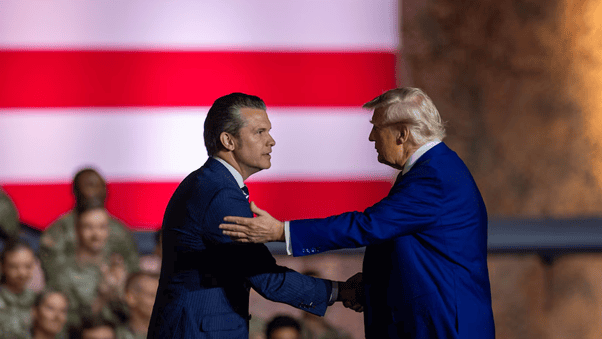
Just published, the 2026 National Defense Strategy operationalises the seismic shift introduced by the Trump administration and formalised in last year’s National Security Strategy. Accordingly, US defence will prioritise the homeland with the Western Hemisphere and the Indo-Pacific region, with Europe increasingly treated as a secondary theatre as its relative economic weight declines.
The strategy reassures that the United States will remain „engaged” in Europe, but it will recalibrate its force posture and activities in the theatre. The emphasis shifts from quantity to quality, favouring ”limited but critical” support. Europeans are therefore expected to assume „primary responsibility” for their conventional defence, while the US focuses on providing strategic enablers such as intelligence sharing, operational planning and advanced capabilities.
Incentivising and enabling the 5% pledge
Central to this approach is delivering on NATO allies« Hague commitment to spend 5% on defence, which the Department of War aims to „incentivise and enable”. To that end, Washington plans to leverage NATO processes, expand transatlantic defence-industrial cooperation, and reduce defence trade barriers to accelerate European rearmament.
Russia as a persistent but manageable threat
The strategy describes Russia as „a persistent but manageable threat to NATO’s eastern members for the foreseeable future”. It bases this assessment on the Kremlin’s „deep reservoirs of military and industrial power”, coupled with the „national resolve” demonstrated in its protracted war against Ukraine.
Nevertheless, it asserts that ”Moscow is in no position to make a bid for European hegemony”, as what the strategy calls „European NATO” surpasses Russia several times over in terms of population and economic weight, and thus also in latent military strength.
Based on this rationale, it concludes that Europe is ready to shoulder „primary responsibility” for its conventional defence. It extends the same logic to Ukraine: Europeans are expected to take the lead in sustaining support and to assume primary responsibility for ending the war.
Europe as part of the Eurasian defence perimeter
The strategy seeks to maintain ”favourable balances of power” against all major adversaries, including China, Russia, Iran and North Korea. Achieving this objective requires greater burden-sharing with allies, with Europe expected to take care of Europe.
In this respect, the strategy is guided by a threat-perception logic under which each ally is expected to focus on its most imminent challenge. It frames this principle as follows: „In Europe and other theatres, allies will take the lead against threats that are less severe for us but more so for them.”
More broadly, Europe is envisaged as part of a wider ”defensive perimeter around Eurasia”, made up of US allies and partners such as Japan, South Korea and Australia. The argument is that this network combines significant geographical and economic advantages which, if matched by delivery on the Hague defence spending commitments, could—together with the United States—deter and eventually counter coordinated action by these adversaries.
Europe: securing US support while nurturing autonomy
The strategy makes it crystal clear that the US is willing to play only a limited, supportive and conditional role in Europe’s defence. It implies that ”model allies” will receive priority access to US cooperation, creating a de facto hierarchy in NATO in which some allies are more securely backed by Washington than others.
At the same time, it effectively tells Europe to mind its own business and not meddle in American priorities, stating: ”Finally, we will be clear with our European allies that their efforts and resources are best focused on Europe.” In the current administration’s sphere-of-influence logic, this may also imply that Washington prefers a Europe that is strong enough to secure its own region, but not so strong—or so global in reach—that it begins to compete with US interests elsewhere.
Next, the strategy’s call for deeper defence-industrial cooperation may be difficult to reconcile with Europe’s push for strategic autonomy and reduced import dependence. That ambition runs counter to US interests in cultivating a relationship of dependence, in which Europeans continue to buy American arms, generating billions of dollars and additional leverage for Washington.
Moreover, recurring mentions of ”European NATO” or ”Non-U.S. NATO” in the strategy reinforce fears of the US distancing itself from its European allies and the Alliance itself. This comes amid the deepest transatlantic crisis since the Alliance’s inception, sparked by US threats regarding Greenland, which the text mentions five times as a core terrain for US homeland security.
Interestingly, the document asks Europe specifically to take care of its conventional defence, with „conventional” implicitly excluding the nuclear deterrence provided by the United States. At least rhetorically, this suggests Washington intends to retain its nuclear umbrella for the Alliance, rather than encourage Europe to assume responsibility for the nuclear component on its own.
Lastly, the document overlooks the fact that Europe has already assumed near-full financial responsibility for sustaining Ukraine’s war effort and economy in line with the strategy’s prescriptions. Yet it has not secured a commensurate role in peace negotiations, partly because the United States has often not pressed for European participation.
Overall, this is yet another signal that Europe should not expect decisive US support against the Russian threat. But the strategy also suggests the US is not willing to abandon the continent altogether. This gives Europeans room for manoeuvre to secure limited but critical American support in a moment of crisis, while building the autonomy and independence needed if that support does not materialise.
Such manoeuvring is particularly critical for frontline states such as Poland, which seek to maximise US presence and cooperation and which, in Washington’s logic, are to be „rewarded” for exemplary compliance with their commitments. At the same time, these countries must account for Washington’s unpredictability, recently bordering on a lack of reliability, which offers no guarantee that the United States will consistently honour its declarations. Under these conditions, cultivating strong relations with Washington, while simultaneously building national and European autonomy, becomes even more important.