- WIADOMOŚCI
New division on the border with Poland, in Baltiysk

As announced, a new division has formally been established in Baltiysk in Kaliningrad Oblast. Its formations are fighting in Ukraine, and full formation will take a long time, but the fact is worth recording.
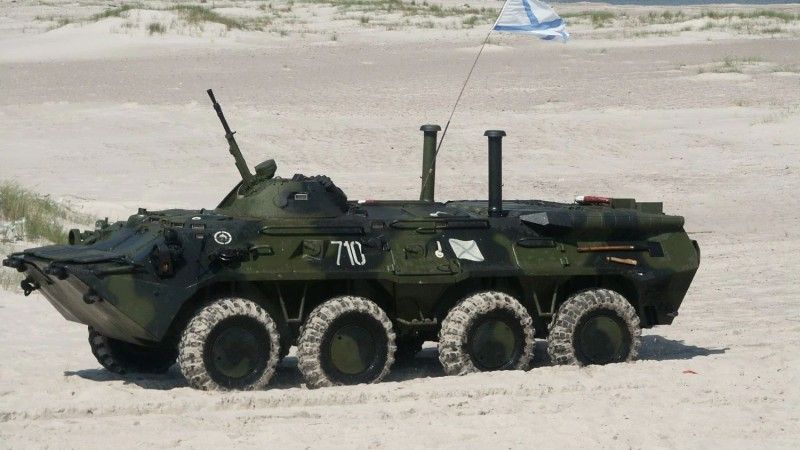
Photo. Jarosław Ciślak/Defence24.pl
Russian naval infantry (marines) has a long history. After World War II it was completely disbanded, but was rebuilt from the early 1960s. Its greatest organizational flourishing — and therefore its highest combat capabilities — occurred in the final years of the USSR. After the formation of the Russian Federation, the force underwent reductions, as did the wider armed forces.
Russian naval infantry before the war in Ukraine
At the beginning of 2022 the Russian naval infantry consisted of five separate brigades and one regiment. These were:
- 40th Separate Marine Brigade, Pacific Fleet;
- 61st Separate Marine Brigade, Northern Fleet;
- 155th Separate Marine Brigade, Pacific Fleet;
- 336th Separate Marine Brigade, Baltic Fleet;
- 810th Separate Marine Brigade with the subordinated 382nd Separate Marine Battalion, Black Sea Fleet;
- 177th Separate Marine Regiment, Caspian Flotilla.
Until the end of the first decade of the 21st century these brigades comprised brigade headquarters and subordinate separate battalions and squadrons. For example, the geographically closest to us, the 336th Brigade, consisted of:
- 877th Separate Marine Battalion;
- 879th Separate Air-Assault Battalion;
- 884th Separate Marine Battalion;
- 724th Separate Reconnaissance Battalion;
- 1592nd Separate Self-Propelled Artillery Battalion;
- 1612th Separate Self-Propelled Artillery Battalion;
- 1618th Separate Anti-Aircraft Rocket-Artillery Battalion.
In addition, the brigade headquarters TO&E included a number of companies — snipers, signals, flamethrower teams, engineer-assault, logistics, medical, chemical protection — and an anti-tank guided-missile battery.
As a result of the reforms introduced by Defence Minister Serdyukov a number of units, particularly brigades, were merged into single organisations with a single TO&E and a single military unit number. The 336th Brigade was restructured in exactly this way.

Photo. Jarosław Ciślak/Defence24.pl
Obsolete equipment and a shortage of landing craft
Following the collapse of the USSR and a reduction in the size of the naval infantry, no deep technical modernisation was carried out. Much of the equipment remained old. For example, the 336th Brigade until recently employed ZSU-23-4 Shilka self-propelled anti-aircraft guns in an unmodernised configuration. At the beginning of 2022 the brigade numbered fewer than 3,000 personnel on paper and was equipped, among other systems, with 140 wheeled armoured personnel carriers BTR-80A, 18 122 mm 2S1 Gvozdika self-propelled howitzers, 12 120 mm 2S9 Nona-S self-propelled mortars, six BM-21 Grad multiple-rocket launchers and nine 9P149 Shturm-S anti-tank rocket launchers mounted on MT-LB chassis. The brigade’s air defence consisted of the aforementioned Shilka systems and man-portable air-defence systems.
Relatively weak and outdated armament across the marine brigades was compounded by one very important factor: an insufficient number of landing ships and craft to conduct major amphibious operations. Not only were they few in number, they were distributed between four fleets and the Caspian Flotilla. Before 2022 each fleet could theoretically mount a battalion-sized landing group. Theoretically — in practice such a landing would have lacked effective air cover and anti-air defence, and, crucially, logistical support. A landing of that sort would have faced counteraction from the defended state and was unlikely to succeed.
The only tangible strategic effect of Russia’s naval infantry and amphibious forces was the need for other states to take their existence into account. To a limited extent Russian naval infantry participated in the intervention in Syria and in protecting Russian warships and civilian vessels transporting military cargo. It should be noted that nevertheless marine troops were trained more intensively and to a higher standard than ordinary ground forces.
Marines on the Ukrainian front
The inability of Russia to conduct a proper combined operation such as an amphibious landing was confirmed at the start of the war in Ukraine in 2022. Late in 2021 the Black Sea Fleet’s amphibious forces were reinforced by six landing ships transferred from the Northern and Baltic Fleets (three each). That event suggests that the Russians planned an amphibious landing on Ukraine. Why it was not executed remains unclear. On one hand strong Ukrainian resistance may have made such an operation extremely risky given insufficient forces to protect the landing during the sea transit. On the other hand, control of the entire Sea of Azov coast was achieved from the landward side, making a seaborne landing there unnecessary.

Photo. Jarosław Ciślak/defence24.pl
Russian landing ships certainly participated in the transport of personnel and equipment on the Black Sea and the Sea of Azov. The Black Sea Fleet paid a heavy price: a Project 1171 landing ship (NATO: Alligator), two Project 775/II landing ships (NATO: Ropucha-I) and at least four landing craft of Projects 1176 and 11770 were lost irretrievably. Other vessels were damaged.
From the first day of aggression, 24th February 2022, Russian naval infantry personnel have been engaged in ground operations against Ukraine. This applies to all five brigades and the regiment. Russian authorities have repeatedly emphasised the distinguished achievements of these units on the front. The units themselves have often been decorated and granted the honorary title „Guards.” The same applies to the Russian „marines”. Ukrainian sources, however, have repeatedly stressed the heavy losses suffered by these units, both in personnel killed and wounded and in materiel.
The Kremlin invests in the naval infantry
Evidently the Kremlin views its naval infantry — which in practice has been employed as conventional infantry — as useful and has decided to develop it organizationally. The first stage was to increase the numerical strength of existing brigades. At one briefing the commander of the 810th Brigade reported to President Putin that his brigade officially registered more than 10,000 personnel (compared with an authorised strength of roughly 2,300). However, inflating brigades with new contract soldiers did not produce the intended results. Consequently, in the second stage authorities decided to re-organise five separate brigades into five marine infantry divisions, and to re-designate one separate regiment as a separate marine brigade. The Navy’s Commander-in-Chief announced this first on 10th January 2024. These announcements were subsequently repeated many times, but without confirmation by concrete events.
Only recently it was announced that two brigades were formally reformed into divisions with effect from 1 December 2025. Thus:
- The 155th Separate Marine Brigade was reformed into the 55th Marine Infantry Division;
- The 336th Separate Marine Brigade was reformed into the 120th Marine Infantry Division.
The new 55th Division in the Pacific has assumed the number of its predecessor — a division that existed there from 1st December 1968 until 1st December 2009 (after which it was reformed as the 155th Brigade).
The new 120th Division in the Baltic is an entirely new tactical formation. Formally it will be garrisoned in Kaliningrad Oblast, with its headquarters in Baltiysk. Currently the division is fighting in Ukraine, and in the Oblast only new contract soldiers are training before being deployed to the front and conscripts who, by design, are not sent to Ukraine.
We must remember, however, that if the war ends the entire 120th Division will be stationed right on our border.
At present there is no reliable information about the intended structure, strength or armament of the newly forming marine infantry divisions. With the organisational upgrade to division level they will certainly include marine infantry regiments and again separate battalions and squadrons. It is not known whether divisional artillery and air defence will be organised into regiments or battalions.
Analogies to the former 55th Division may be misleading. It was formed in Soviet times and then included three marine infantry regiments, a tank regiment, an artillery regiment, an anti-aircraft missile regiment and separate battalions and squadrons of supporting arms. In 1989 it was equipped with 153 T-55A tanks and 207 armoured personnel carriers (BTR-60PB and BTR-80) and a substantial self-propelled artillery park consisting of 48 122 mm 2S1 Gvozdika, 24 152 mm 2S3 Akatsiya, eight 120 mm 2S9 Nona-S, four 120 mm 2S23 Nona-SWK self-propelled mortars and 18 BM-21 Grad multiple-rocket launchers. Under Russian administration it was already reduced, among other changes, by the loss of its tank regiment, and one of its marine infantry regiments was placed into cadre status — later it was reduced to the 155th Brigade.

Photo. Jarosław Ciślak/defence24.pl

The Kremlin strengthens Kaliningrad Oblast
It is not yet known where the 120th Division will be garrisoned after its potential full return to Kaliningrad Oblast. The Baltiysk garrison alone is likely insufficient and its units will probably need to be located in other garrisons. The Oblast already hosts the 11th Army Corps in peacetime. Once part of the Baltic Fleet, the corps in 2024 was subordinated to the command of the Leningrad Military District in Saint Petersburg as a result of Russia’s reorganization into five military districts. The 11th Corps is not yet a large operational-tactical formation, but there are reports that in the long term it is planned to be restructured into a combined-arms army.
After the collapse of the USSR and during the withdrawal of Russian units from the former GDR and Poland, Kaliningrad Oblast became for a time a heavily militarised area. Over time however the number of troops and materiel stationed there was drastically reduced. At the beginning of the previous decade the Oblast hosted only the 79th Separate Mechanised Brigade, the 11th Separate Tank Regiment and the 7th Separate Mechanised Regiment. The establishment of the 11th Army Corps in 2016 began to restore combat capabilities in local units. In 2020 the 18th Mechanised Division was formed from the 79th Brigade and the 11th Regiment, but by 2022 it had not developed to full authorised TO&E.

Photo. Jarosław Ciślak/defence24.pl
In summary, today the Russian naval infantry consists of two divisions, two separate brigades and one separate regiment. Upon completion of the transformation process it is intended to comprise five divisions and one separate brigade. The trend of expansion is further evidenced by the establishment on 1 December 2025 of a Naval Infantry Command, subordinated to the Main Command of the Russian Navy.
For Poland this means that the land forces garrisoned in Kaliningrad Oblast formally comprise the 11th Army Corps and the 120th Marine Infantry Division. Today a small portion of these forces is stationed on our border while a larger portion is fighting in Ukraine. It can be expected, however, that these troops will at some point return to their home garrisons. We will therefore watch closely for developments there.