- WIADOMOŚCI
- KOMENTARZ
Three Seas Initiative’s strategic relevance is even more pronounced today, former Polish and Croatian presidents say

Recent developments have only reinforced the strategic relevance of the Three Seas Initiative, say the founding figures behind one of Central and Eastern Europe’s most ambitious regional projects.
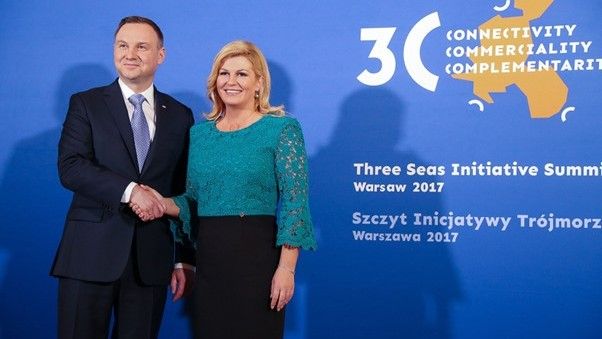
“The strategic meaning has not changed; it has only been underlined,” said former Croatian president Kolinda Grabar-Kitarović, speaking about the Three Seas Initiative during a discussion with former Polish president Andrzej Duda at Defence24 Days, the largest security conference in Central and Eastern Europe, held in Warsaw on 6–7 May.
Grabar-Kitarović first explained that “the point was to connect,” pointing to Europe’s long-standing neglect of north–south connectivity. The Three Seas Initiative, she said, was “not established to divide but to complete” the EU and NATO through infrastructure, energy, and digital projects, which are all inherently dual-use. Duda added that the initiative was particularly about using European funds “more efficiently.”
Growing military and strategic relevance
Duda admitted that military security per se was not central to the initiative at the beginning, when energy security dominated the agenda. Yet the military dimension of energy security has become „much more visible” today, he noted, amid Europe’s broader push to diversify and de-risk supplies. In recent years, this military aspect has gained further salience, as the war in Ukraine has underscored the importance of energy, transport, and logistics for effective and sustained military operations.
Ukraine itself is currently a partner-participant in the initiative, and Duda expressed hope that it will join fully once admitted to the EU. Both presidents highlighted that the infrastructure of Three Seas countries is already vital to Ukraine’s war effort and will be equally important in supporting its post-war recovery.

3SI's ongoing evolution and future
Connecting countries and people remains the initiative’s core purpose, but its mission is evolving. At the recent Dubrovnik Summit, leaders agreed to establish finance as the fourth pillar, recognizing its importance for delivering concrete projects. Grabar-Kitarović also pointed to a growing focus on countering disinformation and building societal resilience against Russian hybrid warfare.
Both speakers also pointed to the initiative’s growing business dimension, with Three Seas Initiative Business Forums attracting thousands of companies and entrepreneurs from across the region and beyond.
Duda, meanwhile, stressed the initiative’s apolitical nature. When asked whether the diversity of member states could become an obstacle, he said partners from outside the region do not ask about parties or politicians, but about concrete projects. “This is not an ideological project,” the former Polish president said, adding that “infrastructure is independent from ideology”, which, in his view, helps facilitate compromise.
Looking ahead, Grabar-Kitarović said the region has “inherited the past, but we build the future,” while Duda underlined that the development and modernization of infrastructure remains a “never-ending story.”
See also


A promise yet to materialise
Andrzej Duda and Kolinda Grabar-Kitarović were the founding figures behind the Three Seas Initiative, launched in 2015. Spanning countries between the Baltic, Adriatic and Black Seas in Central and Eastern Europe, the 3SI was designed primarily to advance cooperation on strategic infrastructure projects across transport, energy and digital domains. Yet it has not emerged as the major political and security actor in Europe that some had once hoped for, largely due to limited internal cohesion, uneven political will, and ambiguity over its role within the broader European architecture.
In this context, the Russian threat, concerns over U.S. credibility, and varying threat perceptions across Europe have revived the question of whether the Three Seas Initiative can realistically enhance interoperability, strengthen transport and logistics capabilities, and support a more coordinated regional response to shared threats, particularly those posed by Russia. Duda and Grabar-Kitarović argue in favour, but whether their successors can carry that legacy forward is the far more important and uncertain question.