



- ANALIZA
- WIADOMOŚCI
Russia focuses on ASEAN

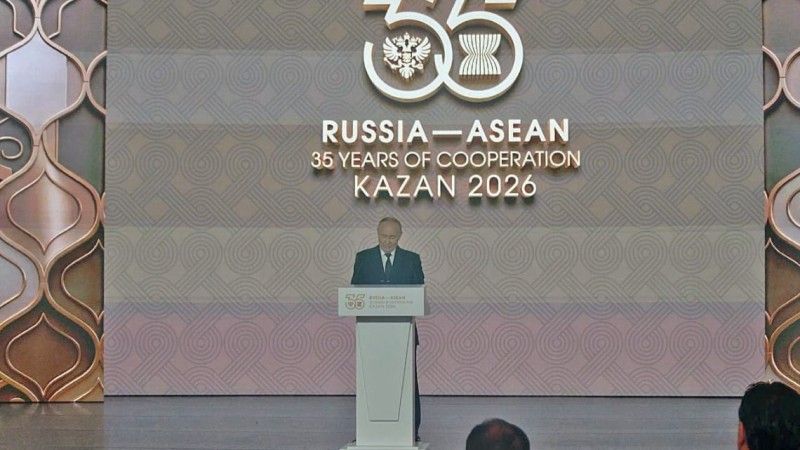
Photo. asean.org
The Russia–ASEAN summit in Kazan was not only a regional diplomatic event. It was part of Moscow’s attempt to rebuild influence outside Europe, show that Western pressure has not isolated Russia and strengthen its position in Southeast Asia at a moment when the region is shaped by competition between the United States and China.
On 18 June 2026, Russia hosted the Russia–ASEAN summit in Kazan, marking 35 years of relations between Moscow and the Association of Southeast Asian Nations. The meeting followed the business forum “Russia–ASEAN: Partnership Without Borders”, focused on information technologies, artificial intelligence, trade, transport, logistics and cooperation between ASEAN and the Eurasian Economic Union.
The list of participants was politically important. Vladimir Putin was joined by Brunei’s Sultan Hassanal Bolkiah, Philippine President Ferdinand Marcos Jr., Vietnamese Prime Minister Le Minh Hung, Cambodian Prime Minister Hun Manet, Malaysian Prime Minister Anwar Ibrahim, Singaporean Prime Minister Lawrence Wong, Thai Prime Minister Anutin Charnvirakul, East Timor’s Prime Minister Xanana Gusmão and Indonesian Foreign Minister Sugiono. Russia wanted exactly this image: Asian leaders sitting with Putin at a time when the West is trying to limit Moscow’s diplomatic room.
The bilateral track mattered even more than the summit itself. Putin held meetings with representatives of the Philippines, Brunei, Malaysia, Laos, Cambodia, Vietnam, East Timor, Thailand and Singapore. These talks covered energy, defence-technical cooperation, trade, logistics and cultural exchanges. This is how the Kremlin works. It uses a large multilateral format to create the political stage, and then builds practical influence through bilateral contacts on the margins.

Russia knows how to use regional formats. The Russia–Africa summits are the best example. They are not only about trade or declarations. They are instruments of political access, anti-Western messaging, military cooperation, energy deals, food diplomacy and influence-building in states where Moscow competes with Europe, the United States and China. The Kazan summit with ASEAN follows the same logic.
For Moscow, this is a way to counter the narrative of isolation. Russia cannot break the Western sanctions system through one summit, but it can show that many states outside Europe do not want to cut ties. ASEAN countries have their own interests. Some are close to the United States. Some are deeply connected to China. Others want Russian energy, fertilisers, weapons, nuclear technology, cybersecurity cooperation or tourism. Moscow uses this diversity.
The closed-door session in Kazan, focused on integration processes across Eurasia, also showed Moscow’s broader design. The participation of representatives from the Shanghai Cooperation Organisation and the Eurasian Economic Commission was not accidental. Russia is trying to connect ASEAN with the EAEU, the SCO and other non-Western formats. The aim is to build a wider Eurasian space less dependent on Western institutions, standards and logistics corridors.
The same method is visible in other regions. Russia invests in Africa, maintains contacts in South America, protects its interests in the Caucasus and Central Asia, and looks for influence in the Indo-Pacific. These are not separate directions. They are parts of one strategy: to prove that Russia remains a global actor despite the war, sanctions and confrontation with NATO.
See also


For ASEAN states, the summit also had value. Their diplomacy is based on avoiding exclusive dependence on one power. Even countries with strong ties to Washington attended at a high level. This does not mean they support Russia’s war or accept Moscow’s worldview. It means they want options. They want access to energy, technology, arms, food, tourism, trade and diplomatic flexibility.
Energy and nuclear cooperation are particularly important for Russia. Civil nuclear projects, training, long-term maintenance and financing can create dependencies lasting decades. The same applies to defence-technical cooperation, cybersecurity, law enforcement and digital infrastructure. These sectors allow Moscow to remain embedded in state systems even when its broader economic position is weaker than China’s.
The Kazan summit ended with four documents: the Kazan Declaration, the Comprehensive Plan of Action for 2026–2030, and joint statements on energy cooperation and cultural collaboration. These documents will not transform Southeast Asia immediately, but they give Russia a framework for continued engagement, sector by sector and country by country.
For Russia, ASEAN will become increasingly important because Moscow wants to play a two-track game in Asia. On one track, it wants to limit the influence of the United States and show that Washington cannot organise the Indo-Pacific only through its own alliances and partnerships. On the other, it wants to avoid a situation in which China becomes the only serious non-Western power shaping the region’s energy, infrastructure, security and political choices. Russia needs China against the West, but it does not want to disappear behind China.

This is where Europe should pay attention. If Russia is trying to rebuild influence in ASEAN through energy, nuclear technology, trade, cybersecurity, tourism and bilateral diplomacy, then Europe cannot treat Southeast Asia as a distant theatre. The question is how the EU, France, Germany and other European states will build their own presence there: through investment, digital infrastructure, defence cooperation, maritime security, supply chains, education and political dialogue.
Europe (the few states that possess the necessary capabilities) must decide whether it wants to compete for influence or only comment on the competition between Washington, Beijing and Moscow.


