



- ANALIZA
- WIADOMOŚCI
- PILNE
France is preparing Europe for defence without the USA

In French thinking on security, the assumption that Europe must be ready to defend the continent without the involvement of the United States is becoming increasingly explicit.
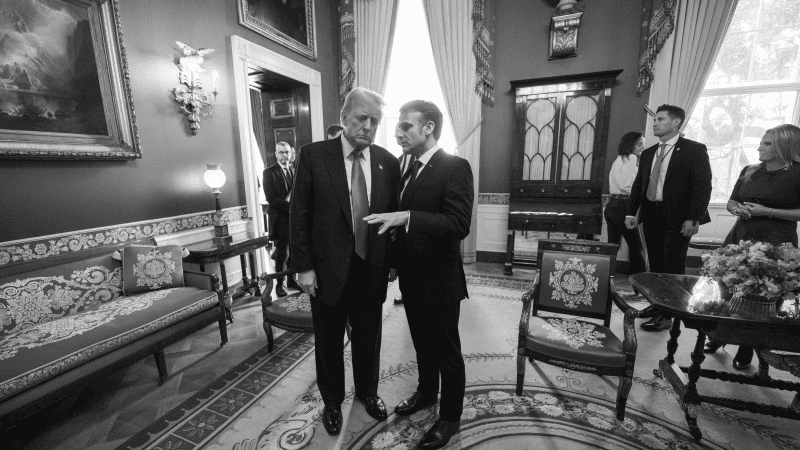
In strategic and operational planning, almost complete European autonomy is assumed, together with the exclusion of US presence, including in scenarios for the defence of the Baltic Sea.
In French military analyses, transatlantic relations are increasingly seen as less and less predictable. The United States is assessed not only as an ally, but also as a competitor at the political, economic and military levels. Reference is also made to Europe’s dependence on American technologies, data, military equipment and information. These factors further undermine confidence in the United States in the field of security.
As a consequence, Paris, while maintaining permanent consultations with allies, assumes the broadest possible degree of self-reliance, based on national and European capabilities. Defence scenarios do not take into account the automatic involvement of US forces in NATO defensive operations, including in the Baltic. The defence of the region is to be carried out exclusively by European states, with the burden of action resting on the frontline states supported by the largest armies of Western Europe, namely France, Italy, Spain and the United Kingdom.
This is no longer merely a scientific or political debate, but increasingly more tangible variants being considered in Europe in the event of a reduction or change in the American presence on the continent. Such possibilities are being discussed both in Paris and in the United States, so it is important that these scenarios are also heard in Warsaw.
Baltic - the proving ground
In French analyses, the Baltic Sea is treated as one of the most likely locations for a rapid escalation of conflict with Russia. This is determined by the short distances between NATO states and Russia, the density of Western critical infrastructure, and Russia’s significant capabilities to carry out missile strikes and use the maritime component for offensive operations. It is assumed that the conflict would begin with actions at sea, port blockades, missile strikes and hybrid activities (sabotage, subversion, cyber-attacks, etc.) in the Baltic states before open land confrontation takes place.
The scenarios foresee intensive use of Russian maritime capabilities, including submarines, as well as strikes against energy infrastructure and command systems. The European response is to be joint: land-air-sea, with emphasis on coastal defence, anti-submarine warfare and maintaining freedom of navigation in the Baltic.
Europe’s capabilities
French assessments emphasise that Europe’s missile defence capabilities are insufficient, particularly on the eastern flank. The number of available defensive assets is too small relative to the potential threat. In addition, there is the question of Russia’s use of thousands of unmanned systems. In such a situation, some of the variants under consideration assume not only defence, but also the rapid neutralisation of Russian capabilities in the immediate vicinity of the Baltic. For this reason, initiatives aimed at slowing down and blocking the Russian offensive through strikes on Kaliningrad are viewed favourably, as a way of buying time for an allied response.
The “European” variant of the plan for the defence of the Baltic Sea basin involves the use of significant land, air and naval forces; however, logistics remain the key limitation. The analyses stress that the capabilities for moving troops and equipment remain insufficient in relation to requirements and require the support of the largest European states. The transfer of French forces alone to the eastern flank and to the Baltic could take around 8 days (depending on Paris’s involvement in other conflicts and exercises).

At the beginning of March this year, in the face of a growing tense situation in the Middle East, France decided to redeploy the aircraft carrier Charles de Gaulle, which was then in the Baltic, to the Mediterranean Sea. The US and Israeli war against Iran showed that even amid growing interest in the Baltic, France is unable to concentrate key forces permanently on just one axis.
In the “European” variant, responsibility for the defence of the Baltic Sea basin would rest primarily with the frontline states: Poland, the Baltic states, Finland, Sweden, Denmark and Norway. Their task would be to conduct delaying operations, defend territory and maintain logistics. Operational support would be provided by France, Germany and the United Kingdom, supplemented by Belgium and the Netherlands, mainly in the areas of air power, naval forces, command, reconnaissance and force deployment.
It is assumed that the “European” variant of Baltic defence would require the use of around 12 divisions (comprising 40–50 brigades in total), with approximately 200,000 troops altogether. These forces would need to have at least 1,500 tanks, more than 3,500 infantry fighting vehicles, around 1,000 field artillery systems (mainly 155 mm howitzers), and nearly 400 rocket launchers. In the air, it would be necessary to deploy 300–350 combat aircraft, around 20 early-warning aircraft, reconnaissance and air-to-air refuelling aircraft, as well as several thousand precision-guided medium-range strike assets. The naval component would include one carrier strike group and up to four surface naval task groups with mine countermeasure, anti-submarine warfare and critical infrastructure protection capabilities.
Europe without the US support?
The French approach means preparing Europe for a scenario of defence without the American umbrella. This is not a break with NATO, but an attempt to free planning from political uncertainty in Washington. However, the problem remains the lack of a coherent command system and genuine capabilities to manage such a large operation solely at the European level.
At the White House, not merely theses but open proposals are already being put forward to reduce the presence of US troops across NATO’s eastern flank. Moreover, for months the Trump administration’s expectations of its partners on the Old Continent have been emphasised: that Europe should finally begin to take responsibility for its own security. The United States sees China as the main challenge, while Europe is important primarily in the context of Russia’s war against Ukraine. The aim remains to bring about de-escalation and an agreement, with much greater pressure being placed on Kyiv than on Moscow. Equally important remains the thawing of relations with Minsk, which is to serve as an independent outlet to Moscow, as well as efforts to pull it away from Beijing.
Paris’s relations with Washington have reached their lowest level in years (as have Macron’s personal contacts with Trump), and voices in France are now quite strong in arguing that help from the United States should not be expected in the defence of Europe. However, I believe that the French perspective is too one-sided and completely ignores the fact of the American presence in Poland, Romania or Estonia. There are several thousand American soldiers on NATO’s eastern flank, whom the United States continuously rotates and maintains. The political game between France and the United States must also be taken into account.
Nevertheless, the concept of “European defence” discussed here is ceasing to be purely theoretical for the French. Concrete scenarios, exercises and talks with allies, including states on NATO’s eastern flank, are emerging. The Baltic has been identified as the most likely flashpoint where European unity will be tested, as well as an area where an allied response may be initiated: from sending soldiers and equipment to triggering NATO Article 5 or some other form of tangible assistance from partners. In practice, such considerations mean growing French pressure on Central and Eastern European states to build capabilities not as a complement to the US presence, but as part of a strictly European defence system. It must be acknowledged that this is a fundamental change in thinking about the continent’s security, with consequences that are only now beginning to become visible.
Written with: Antoni Walkowski


