



- WIADOMOŚCI
Transatlantic relations remain strong despite tensions. Takeaways from Defence24 Days

This year’s conference Defence24 Days featured a panel discussion titled „Transatlantic Relations in the New Reality”, focusing on relations between the United States, Canada, and the European countries of Sweden and Poland in light of the policies of the Donald Trump administration, particularly its approach to NATO and the decision regarding war with Iran. The discussion was moderated by Robert Pszczel, a former diplomat and currently an analyst at the Center for Eastern Studies (OSW).
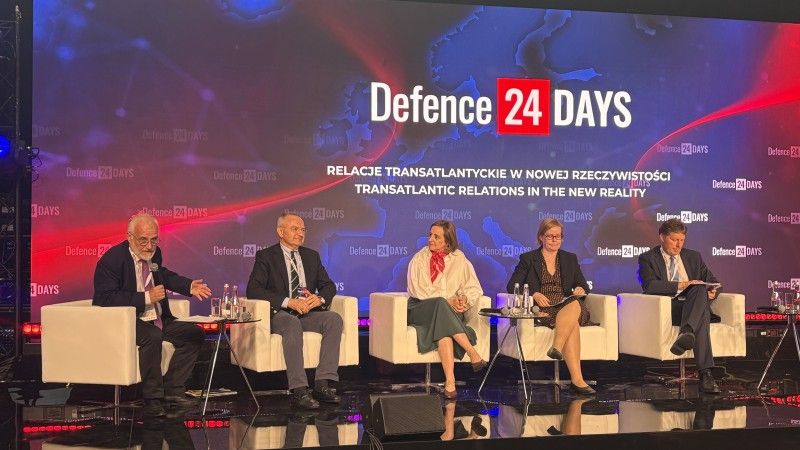
Photo. Defence24
The panel featured:
- Adam Bugajski, Director of the Security Policy Department at the Ministry of Foreign Affairs,
- Catherine Godin, Canadian Ambassador to Poland,
- Andrew Michta, Director at the Atlantic Council's Scowcroft Center for Strategy and Security,
- Martina Quick, Swedish Ambassador to Poland.
Relations between Europe and the United States remain the cornerstone of NATO’s security, but their nature is currently undergoing significant changes. The U.S. expects European countries to increase their defense spending and take on greater responsibility for security in the region, while shifting its focus away from Russia. Transatlantic relations have also been affected by recent decisions regarding the war in Iran, which have had a significant impact on European energy markets. Cooperation among nations remains crucial for maintaining deterrence, the interoperability of armed forces, and the credibility of alliance commitments.
As Andrew Michta emphasized, European countries must increase their defense spending. However, it is not just a matter of increasing spending as a percentage, which loses its significance if it is almost entirely allocated to personnel costs. As he said, „we need to translate this defense spending into defense capabilities”, linked to regional plans. He noted that the U.S. can no longer provide military support to Europe to the same extent as before: „Our national debt is nearly $40 trillion (…) The belief that we can continue on our current trajectory without Europeans taking responsibility for conventional deterrence and defense is mistaken.” At the same time, he emphasized that NATO remains important to Americans: „For America, NATO is a force multiplier that allows us to maintain our prosperity, access to global resources, and defend our homeland.”
The other panelists agreed with him that it is time for a shift in thinking about the security of individual nations as well as the entire North Atlantic Treaty Organization. „We are at a point where we must make a strategic reset of the way we operate,” said Catherine Godin. She emphasized that „the war in Ukraine has allowed us to see the shortcomings and flaws in our system,” and that the „just-in-time” procurement system is now a thing of the past. „We need to have serious conversations about defense procurement because we simply don’t have much time,” the Canadian ambassador emphasized.
As the Swedish ambassador—representing NATO’s newest member—noted: „Our NATO membership is a direct result of these changes. Russia’s full-scale invasion of Ukraine and the deteriorating security situation in the Baltic Sea prompted us to apply for membership.” Martina Quick also acknowledged that U.S. allies must contribute more to ensuring Europe’s security, but emphasized that this must happen gradually so that the continent is not weakened during the transition period. Adam Bugajski also agreed that a key process in the coming years will be the shift in the burden of responsibility, involving greater engagement by Europe and Canada in conventional deterrence. He emphasized that „the expectations of the U.S. and European leaders are not contradictory.”
See also

The panelists noted that what causes tension in relations between the U.S. and its other allies includes differences in the perception of threats from Russia and China. For Europeans, especially those in eastern countries like Poland or Sweden, Russia remains a very real threat. Americans, on the other hand, point out that Russia’s imperial ambitions have no chance of success, and note that China seeks to alter the global balance based on its ideology and economic model. Europeans view China primarily as an economic competitor to their domestic industries.
Another issue is the approach to the war in Iran. According to Professor Michta, the war was a mistake to happen at that point, but he believes it is unacceptable for a European country to deny access to its bases and airspace while the U.S. is conducting a military campaign.
The panelists agreed, however, that relations between North America and Europe are essential for the security of both sides and remain strong despite political tensions. Finally, the moderator asked the panelists to rate current transatlantic relations on a scale of 1 to 10. Despite their differences, it turned out that all participants in the debate still rated them highly, with the highest score – 10 out of 10 – given by Andrew Michta from the U.S. As Adam Bugajski summarized: „we are likely in the best state of bilateral relations (with the U.S. – ed.) in the history.” The Swedish ambassador noted that „the European security architecture is based on a close transatlantic relationship, which is more important today than ever before.”

Photo. Defence24.pl


