- ANALIZA
- WIADOMOŚCI
Armenia's 2026 elections shadowed by Russia

Armenia’s upcoming parliamentary elections, scheduled for June 7, 2026, will be one of the most important political tests since the 2018 „Velvet Revolution”. At stake is not only the maintenance of power by Prime Minister Nikol Pashinyan and his Civic Contract party, but also the direction of the country’s foreign policy, the future of the peace process with Azerbaijan, and Armenia’s place between Russia and the West.
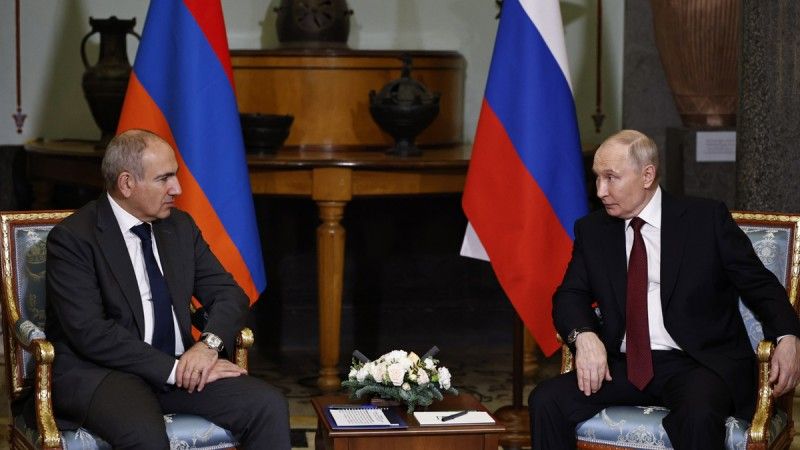
Photo. The Office to the Prime Minister of the Republic of Armenia
Elections as a Geopolitical Referendum
These elections are seen not only as a contest between the current government and the fragmented opposition, but above all as a referendum on the future direction of the country’s foreign policy. Thus, for the first time since regaining independence, the choice between further integration with the European Union and maintaining strategic dependence on Russia has become the central theme of the election campaign.
Prime Minister Nikol Pashinyan and the ruling Civic Contract Party are presenting their vision for „normalizing” relations with Azerbaijan and Türkiye, deepening cooperation with the European Union and the United States, while maintaining pragmatic relations with Russia. In March 2025, the Armenian Parliament launched the formal process of European integration. During the campaign, Pashinyan also announced that Armenia could achieve visa-free travel with the EU within two years.
Civic Contract – dominance, but under pressure
Since coming to power in 2018, the above-mentioned Civic Contract Party has remained the main political force in Armenia. Despite a serious crisis triggered by its defeat in the Second Nagorno-Karabakh War in 2020, the party managed to maintain public support and win the early parliamentary elections in 2021. It currently remains the clear leader in the polls, with around 32% support.
Pashinyan is campaigning around the concept of a „Real Armenia”, which entails accepting the country’s current borders and normalizing relations with Azerbaijan and Türkiye, a proposal that has not been well received by some segments of society. At the same time, he has announced the creation of a „Fourth Republic of Armenia” based on a new constitution – a key demand in the peace talks with Azerbaijan as well. The Prime Minister warns that an opposition victory could lead to a new war in the South Caucasus and jeopardize the opportunity to normalize relations with neighbouring countries, a development that would benefit all parties involved, including Armenia.
Strong Armenia – a new influential player
The biggest political surprise of the campaign has been the emergence of the Strong Armenia movement, associated with Russian-Armenian billionaire Samvel Karapetyan. Although he was not actively involved in politics a year ago, his movement currently ranks second in the polls.
Karapetyan entered politics following a conflict between the government and the Armenian Apostolic Church. His arrest on charges of attempting to seize power, followed by accusations of money laundering, has made him a symbol of resistance to the government for some voters. Despite his nephew formally leading the campaign, Karapetyan himself remains its principal architect.
However, his extensive business ties to Russia and reported contacts with Russian intelligence services remain a key source of concern. Critics question his ability to pursue a sovereign foreign policy and warn that his rise could lead to renewed dependence on the Kremlin.
Armenia Alliance – return of the old elite
The Armenia Alliance is once again led by former President Robert Kocharyan, one of the most controversial figures in contemporary Armenian politics. Born in Nagorno-Karabakh, Kocharyan represents a more pro-Russian stance than the current government and criticizes Pashinyan for weakening relations with Moscow.
Although the alliance remains the main representative of the traditional opposition, its support is currently limited, hovering at around 3%. The campaign focuses on criticism of Azerbaijan’s policies and calls for the restoration of more balanced relations with Russia.
Prosperous Armenia – populism and legal issues
Gagik Tsarukyan’s Prosperous Armenia Party is once again attempting to play a significant political role by forming a broad electoral coalition with other opposition groups. The party’s campaign is based on slogans of prosperity and peace, but has been overshadowed by controversies surrounding Tsarukyan’s ties to Russia and his long-standing relationship with Belarusian leader Alexander Lukashenko. Despite its high visibility, the party currently garners only about 1% of the vote.
Growing Fragmentation of the Political Landscape
This year’s elections are characterized by an exceptionally fragmented political landscape, which seems to favour the currently ruling party. In addition to the main parties, numerous new political parties and movements are competing for voter support.
The Meritocratic Party of Armenia represents one of the most unequivocally pro-Western positions, advocating withdrawal from Russian-led structures such as the Eurasian Economic Union (EAEU), the Collective Security Treaty Organization (CSTO), and the Commonwealth of Independent States (CIS).
The New Power Party, led by former Mayor of Yerevan and popular comedian Hayk Marutyan, bases its campaign on political satire, primarily targeting Pashinyan. The Armenian National Congress, associated with Armenia’s first president, Levon Ter-Petrosyan, adopts a more pragmatic stance, supporting the normalization of relations with Azerbaijan and Türkiye while simultaneously promoting the development of new trade routes. Meanwhile, the Wings of Unity Party, led by former Human Rights Defender Arman Tatoyan, is attempting to attract a conservative-patriotic electorate, although it is also facing scrutiny over allegations concerning campaign financing and possible ties to Russian political consultants.
As a result, the parliamentary elections have evolved into a political contest between competing visions of Armenia’s future. Considering the profiles of the aforementioned parties, it is evident that foreign policy remains one of the central issues of the campaign, particularly regarding the country’s future relations with the West and Russia.
In practice, Armenian political forces can be divided into three main camps.
The first camp is represented by the Civic Contract Party, which seeks to pursue a balanced foreign policy between Russia and the West while deepening cooperation with the European Union and the United States.
The second camp consists of groups such as the Armenia Alliance, Prosperous Armenia, and Strong Armenia, which advocate maintaining or restoring close relations with Russia.
The third camp comprises clearly pro-Western parties, including the Meritocratic Party of Armenia, Rally for the Republic, the Christian Democratic Party of Armenia, and Bright Armenia. These parties advocate further limiting Moscow’s influence and strengthening Armenia’s integration with Western institutions.
Russian influence declines, but pressure remains
Armenia’s political trajectory changed following the Second Nagorno-Karabakh War and growing public disillusionment with the passive stance of Russia and the Collective Security Treaty Organization (CSTO), which failed to provide Armenia with the expected support during the security crises of 2020–2023. Since then, Yerevan has embarked on a gradual geopolitical reorientation toward the West, consistently diversifying its international partnerships, including cooperation with the United States, the European Union, and France.
Moscow has responded to this process with increasingly evident economic pressure. In the weeks leading up to the elections, Russia restricted imports of numerous Armenian products, including fruits, vegetables, fish, flowers, alcohol, and mineral water. Officially, these restrictions were justified on sanitary and technical grounds, but the timing of their introduction – immediately before the elections – sparked considerable controversy. The scale and simultaneity of these measures led many observers to perceive them not as routine regulatory actions but as part of a broader political strategy. The Kremlin thus sent a signal to Armenian elites and voters that further strengthening relations with Brussels may entail tangible economic costs that Yerevan will find difficult to overcome.
However, the most visible instrument of pressure remains the energy sector. Armenia remains heavily dependent on Russian energy supplies. It is estimated that as much as 82% of Armenia’s imported gas came from Russia in 2025. Vladimir Putin publicly noted that Armenia pays approximately $177 per 1,000 cubic meters of gas, whereas European prices exceed $600. A few weeks later, the Russian Ministry of Foreign Affairs warned that Armenia’s continued efforts to join the European Union could result in the suspension of preferential supplies of gas, oil, and industrial diamonds.
At the same time, Russia began questioning Armenia’s future in the Eurasian Economic Union (EAEU). In late May, representatives of the organization suggested the possibility of suspending Armenia’s membership, arguing that the country should clearly define whether it intends to pursue a European path or remain part of the Russian-led integration project. Such a scenario would have significant consequences for Armenia’s economy, as Russia accounts for approximately 35% of the country’s foreign trade, while the European Union’s share stands at only around 11%.
European Union responds to Russian economic pressure
Amid Russia’s intensifying economic pressure on Armenia ahead of the parliamentary elections, the European Union has made an unprecedented show of support for Nikol Pashinyan’s government. European Commission President Ursula von der Leyen announced an assistance package worth more than €50 million aimed at mitigating the impact of Russian trade restrictions on the Armenian economy. The support includes not only financial assistance but also improved access to the EU market for selected Armenian agricultural and food products, which would partially offset the losses resulting from Russian import restrictions.
Von der Leyen also accused Moscow of using economic relations as a tool of political influence, describing Russia’s actions as „economic coercion”. In her view, the Kremlin is employing mechanisms previously used in other post-Soviet states, including Ukraine, Moldova, and Georgia, leveraging trade and energy dependencies to exert pressure on political decision-making in Armenia.
Russian attempts to interfere in the elections
The issue of possible Russian interference in the elections has become a major topic of public debate both in Armenia and abroad. Independent media outlets and security agencies have reported on the activities of Russian influence networks, disinformation campaigns, and attempts to support pro-Russian political groups. Reports concerning Samvel Karapetyan’s alleged ties to Russian security services, as well as accusations of espionage against certain politicians associated with Prosperous Armenia, have attracted particular attention.
Even more concerning were reports indicating that Russian officials had discussed a plan to facilitate the return of up to 100,000 Armenian-born residents of Russia to participate in the elections and vote for opposition groups. According to sources cited by Reuters, the estimated cost of such an operation could have reached approximately $50 million. Although there is no evidence that the plan was ever implemented, the very fact that it was reportedly considered demonstrates the scale of Russia’s interest in the election outcome.
At the same time, media-monitoring organizations have pointed to extensive information campaigns conducted on social media platforms to shape voter preferences. According to data from the Meta Ad Library, approximately $480,000 was spent on political advertisements on Facebook between February and May 2026 – the highest level recorded in the country’s history. The Strong Armenia movement was particularly active, allocating nearly $291,000 to its promotional activities, accounting for more than half of all political advertising expenditure on the platform.
Experts emphasize, however, that official data reflects only part of the phenomenon. A significant share of political content was disseminated through pages that were formally unrelated to politics, including profiles dedicated to entertainment, religion, local events, or social affairs. In practice, this created a vast network of complementary communication channels that published identical content within minutes of one another. Such practices made it more difficult for users to distinguish independent news content from sponsored political messaging, thereby facilitating the spread of political narratives, including disinformation and fake news.
Additional controversy arose from cases in which political advertisements were published without clearly identifying the actual sponsor, in violation of Meta’s transparency guidelines. This included advertisements disseminated through pages associated with the Strong Armenia movement, such as „Strong Armenia Artik” and „Strong Armenia Charentsavan.” As a result, voters were often unaware that the content they were viewing formed part of a paid political campaign.
Artificial Intelligence as a new tool of influence
The use of artificial intelligence in the election campaign raises even greater concerns. Investigative journalists from CivilNetCheck identified at least twelve Facebook pages publishing AI-generated videos depicting purported passersby commenting on the political situation in the country. In these videos, the fictitious „citizens” criticized both the ruling Civic Contract Party and parts of the opposition while largely avoiding criticism of Strong Armenia.
The significance of these materials lay not so much in their content as in their perceived credibility. According to observers, the videos were sufficiently realistic that many users engaged in genuine political debates, unaware that the individuals depicted did not actually exist. This represents a qualitative change in the conduct of political campaigns – from traditional propaganda based on spreading fake news and buying votes, to the creation of an artificially generated social reality.
The Russian dimension of information operations
The challenges facing Armenia’s political space fit into the broader context of the regional information war. Of particular interest was an investigation conducted by the Swedish news outlet Blankspot, which revealed the existence of a confidential document outlining Russian strategies for influencing the Armenian parliamentary elections. According to the report, these activities included promoting pro-Russian narratives, amplifying the messages of groups advocating the restoration of strategic ties with Moscow, and exploiting weaknesses in the local media environment.
These mechanisms resemble patterns previously observed during elections in Moldova, where Russian influence networks used social media, political advertising, sponsored content, and disinformation campaigns to shape public opinion. Particularly significant in the Armenian case is the fact that these activities coincided with Moscow’s attempts to exert economic pressure on Yerevan through trade restrictions and threats concerning energy supplies.
Post-election prospects
All indications suggest that the Civic Contract Party will remain the largest political force in Armenia. However, it remains uncertain whether Pashinyan’s party will once again secure a constitutional majority sufficient to amend the constitution on its own, or whether it will need to rely on support from other political forces to advance constitutional reforms.
The greatest challenge facing the opposition remains its fragmentation and lack of a shared vision for the country’s future. Some parties prioritize close cooperation with Russia, others advocate deeper integration with the West, and still others focus primarily on criticizing the current government. These key differences make it impossible for them to form a unified bloc, which in turn works to Pashinyan’s advantage. As a result, the 2026 elections may prove to be less a contest between competing political blocs than a referendum on Pashinyan’s continued leadership and his strategy for redefining Armenia’s place in the evolving geopolitical order of the South Caucasus.
Regardless of the election outcome, Armenia is likely to continue its policy of gradually diversifying its foreign relations. A victory for the Civic Contract Party would likely result in further rapprochement with the European Union and the United States, accompanied by a gradual reduction in dependence on Russia. By contrast, the success of groups such as Strong Armenia, the Armenia Alliance, or Prosperous Armenia could lead to a partial restoration of Russian influence and a slowdown, or even a complete halt, in the process of European integration.
In practice, the 2026 elections have become a decisive test of Armenia’s geopolitical orientation, with voters de facto having to choose between further diversification of policy towards Western partners and maintaining a Russia-centric security and economic structure.