



- WIADOMOŚCI
- ANALIZA
How modular data centers are built: Inside the factory

Are we witnessing a quiet revolution in the way physical foundations for high-performance computing (HPC) are being built?
Transition to modular infrastructure
Data centers form the physical heart of today’s digital economy, with the construction market projected to reach $275 billion by 2025. These are infrastructure facilities designed for storing, processing, and distributing data. They are essential for the operation of IT systems, cloud services, and advanced computational workloads.
However, with the rapid development of artificial intelligence and cloud computing, the demand for scalable and fault-tolerant infrastructure has grown significantly. The answer to these challenges increasingly comes in the form of modular data centers (MDCs). They represent an evolution of the traditional model, offering integrated infrastructure enclosed within compact modules instead of conventional buildings.
It is projected that by 2031, the modular data center market will grow at a compound annual growth rate (CAGR) of 18.87%. The value of this sector is expected to increase from $41.35 billion in 2025 to $42.65 billion in 2026. According to a report by Mordor Intelligence, it is forecast to reach $101.22 billion by 2031. The figures indicate strong sector expansion over the next five years.

The Advantage of Modular Data Centers
Eric Klassen, CEO of Contour Advanced Systems, pointed out that one of the key growth drivers is the shortened project delivery time. The construction of a traditional data center can take up to two years due to the complexity of on-site construction and integration work. In the case of MDCs, the module manufacturing process takes place in parallel with site preparation, allowing the total deployment time to be reduced to around eight months. The prefabricated modules (roughly the size of standard shipping containers) are delivered to the site in an almost fully completed state. They only require connection to the telecommunications network, power supply, and cooling system.
Another defining feature of modular data centers is their scalability. The infrastructure can be expanded with additional modules as computing power demand grows. This model enables a gradual „as-needed” increase in resources, making it easier to respond to market changes or the growing requirements of research projects without the need for a large one-time investment.
Malte Matthies, Business Development Manager for Modular Data Centers at HPE, also noted that the increasing workloads associated with AI and HPC systems are driving demand for high computing density within limited space. Traditional data centers, which rely primarily on air cooling, are often not designed to meet the extreme power and heat dissipation requirements of modern accelerators and GPUs. Modular data centers, on the other hand, are built for high-density environments (ranging from approximately 40 kW to 400 kW per rack) and integrate advanced cooling technologies, including Direct Liquid Cooling (DLC). This enables the creation of environments capable of supporting a very large number of GPUs, making MDCs one of the leading infrastructure solutions considered for so-called „AI factories.”

Manufacturing Center: Inside Contour Advanced Systems
Hewlett Packard Enterprise (HPE) and Contour Advanced Systems are jointly implementing an MDC production program, combining expertise in IT infrastructure and industrial prefabrication.
HPE is responsible for the computing layer, which includes servers, storage systems, and networking solutions, as well as for designing the architecture that supports the performance and efficiency of the entire IT environment.
Contour Advanced Systems specializes in the design and manufacturing of modular data centers, handling component integration, mechanical and electrical assembly, implementation of cooling systems, pre-shipment testing, as well as final on-site module installation.
Production is carried out under a „one-stop shop” model, in which the entire process (from mechanical design and system integration to final infrastructure and software testing) takes place in a single location: the Contour Advanced Systems facility.
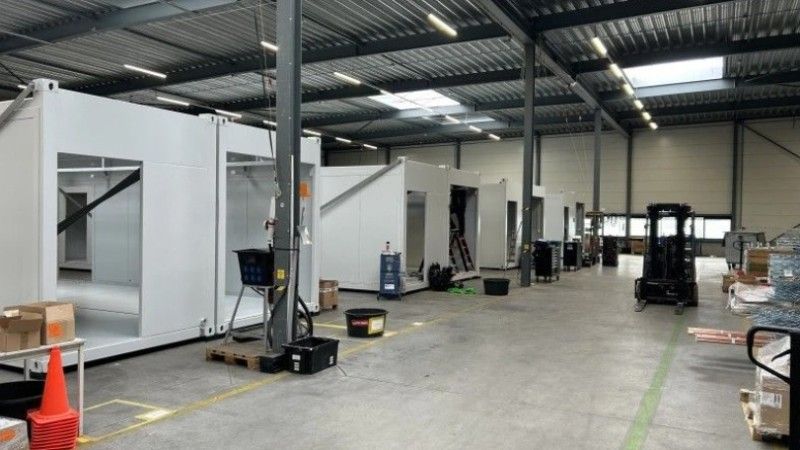
CyberDefence24 editorial team had the opportunity to closely observe the MDC unit production process at this 16,000 m² factory.
Assembly Line: Step-by-step construction
The foundation of the MDC consists of 20- or 40-foot containers compliant with ISO standards. This allows individual modules to be transported by land, sea, or rail. Once an external partner delivers the steel structure, the technological assembly (skeleton) phase begins. During this stage, 19-inch rack frames are installed, forming the basis for servers, storage systems, and the rest of the IT infrastructure.
One of the key challenges in the era of artificial intelligence systems is the efficient distribution of very high electrical power. To meet these demands, the modules are equipped with advanced busbars and dedicated Power Distribution Units (PDUs). The infrastructure is complemented by integrated Uninterruptible Power Supply (UPS) systems, designed to maintain continuous operation in the event of disturbances or voltage fluctuations in the power grid. The high level of energy integration enables a single module to support computing power that, in a traditional setup, would require a significantly larger footprint.
The final stage of assembly involves the installation of the network infrastructure, which serves as the „nervous system” of the data center. It includes a system of fiber-optic connections and cabling that integrates all IT components into a cohesive operational environment. When multiple modules are combined into larger structures, engineers can install up to 650 fiber strands within a single configuration, ensuring adequate bandwidth and connection redundancy.
Cooling System Design (the heart of MDC)
The battle for computing power is, to a large extent, a battle against the heat generated by processors and accelerators. Therefore, if rack frames and cabling form the „skeleton” and „nervous system” of an MDC, then the cooling system serves as its circulatory system; regulating temperature and ensuring the efficiency of the entire computational organism.

Photo. Contour Advanced Systems & HPE
MDC modules employ two main cooling systems, tailored to the module’s purpose and power density. The first relies on air as the heat transfer medium, using heat exchangers (HEX) and chilled-water loops operating at temperatures between 12°C and 24°C. The solution is designed to minimize the energy consumption required for cooling, which in traditional data centers often represents a significant operational cost.
The second system is the aforementioned direct liquid cooling (DLC), which enables the handling of configurations with very high power density. Through the integration of cooling distribution units (CDU) and the chilled-water circuit, it is possible to create a fully fanless module. The absence of moving parts eliminates noise and vibration, while heat is removed directly from the most heavily loaded components, increasing both efficiency and system reliability.
A visit to the factory reveals another important aspect of modular data centers: thanks to thoughtful integration, MDCs are no longer „energy black holes.” The modules can be factory-equipped with heat recovery systems, allowing the capture of energy that would otherwise be lost in traditional facilities and preparing it for reuse. The recovered heat can be directed to local district heating networks or utilized in industrial processes. As our editorial team learned during discussions with company representatives, the only barriers to the widespread adoption of these solutions are regulatory restrictions and the fact that transferring thermal energy requires the company to change its operational status to that of an energy producer.
Testing and Quality Assurance
A key stage in the production of modular data centers is the Factory Acceptance Test (FAT). Before a module is loaded onto a truck, it undergoes a series of internal and external trials that simulate the most extreme operating conditions, ensuring that the client receives a fully operational product. The systems are certified to operate with loads ranging from 40 kW to 400 kW per single rack cabinet, which, in a fully configured container, allows for a total power output of up to 1.6 MW.
The Contour Advanced Systems factory itself holds ISO 9001 and ISO 14001 certifications, emphasizing process quality and environmental neutrality in production. The facility also meets the AQAP 2110 standard requirements, enabling it to carry out projects for the defense sector as well as for the most demanding government institutions.
Delivery, Deployment, and Commissioning
Once the FAT is completed, a logistical operation begins that fully demonstrates the advantage of modular data centers over traditional construction. The modules leave the Dutch facility in a „plug-and-play” configuration, meaning that upon arrival at the prepared site, it is only necessary to physically place the container on its foundation and connect the key utilities: electrical power, fiber-optic network, and cooling water. The entire process takes just a few days, whereas a conventional data center deployment would take months. After final certification is completed, the data center is ready for operation.
A visit to the factory makes it clear that a single container is only the beginning of a larger vision. The true strength of MDC technology lies in its virtually unlimited scalability. Individual units, such as the observed DC16DLC models, can be combined into larger clusters, forming sovereign „AI factories” with immense computing power. In the era of the artificial intelligence arms race, the ability to rapidly expand digital infrastructure without laying new foundations has become a key advantage in the global market.


