- ANALIZA
- WIADOMOŚCI
Kyiv’s pivot: From Minsk to the democratic opposition

Sviatlana Tsikhanouskaya, the leader of the Belarusian opposition in exile, arrived in the Ukrainian capital for her first official visit. She met with, among others, President Volodymyr Zelenskyy and Minister of Foreign Affairs Andrii Sybiha. What is the role and significance of the Belarusian democratic opposition for Ukraine?
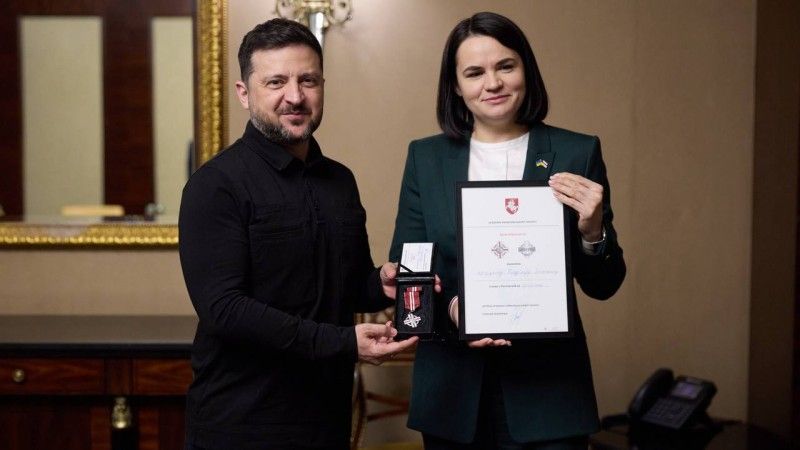
Photo. @Tsihanouskaya/X.com
This was Tsikhanouskaya’s first visit to Ukraine. Before 2026, Ukraine’s relations with the Belarusian opposition remained very limited. The breakthrough occurred at the end of January this year, when Volodymyr Zelenskyy met with the Belarusian opposition leader in Vilnius. They primarily discussed the solidarity of Belarusians and Ukrainians fighting for their states’ independence, albeit in different ways. During the meeting, the Ukrainian president invited the Belarusian opposition leader to Kyiv. As it turns out, we did not have to wait long for Tsikhanouskaya’s visit to Kyiv.
Key events during the visit
The visit began on Monday, May 25. It was previously announced by the Ukrainian Minister of Foreign Affairs Andrii Sybiha. After reaching Kyiv, the Belarusian opposition leader went to the grave of Maria Zaitseva, where she paid her respects to the fallen soldier. Zaitseva took part in the protests in Belarus following the presidential elections of August 9, 2020, and joined the Ukrainian army after the start of Russia’s full-scale invasion of Ukraine. The volunteer was killed near Bakhmut on January 17, 2025.
The next day, the leader of the Belarusian opposition met with Ukrainian President Volodymyr Zelenskyy in Kyiv. Zelenskyy expressed support for the “desire of the Belarusian people to free themselves from Russian interference,” fully aware that Russia is constantly trying to drag Belarus into the war against Ukraine. He noted that he appreciates every manifestation of support from Belarusians for a free Ukraine and looks forward to the moment when relations between Ukraine and Belarus are good and free from their dependence on the Russian Federation. “Ukraine has never posed a threat to Belarus. We are grateful to those Belarusians who now stand on the side of Ukraine, at a time when the fate of our independence and the independence of all nations bordering Russia is being decided,” the president declared.
The leader of the Belarusian opposition also met with Ukraine’s Minister of Foreign Affairs Andrii Sybiha and the leadership of the Coordination Headquarters for the Treatment of Prisoners of War.
During her visit, Tsikhanouskaya also took part in the ceremonial opening of the Mission of Democratic Belarus in Ukraine. The event was attended by Tsikhanouskaya herself and other members of the Belarusian opposition. The Ukrainian side was represented by the Deputy Foreign Minister Yevhen Perebyinis, as well as other officials. The opening of the office is an important step toward systemic cooperation between the actors. It allows members of the Belarusian opposition to always be “on site” and maintain contacts with important partners. Sviatlana Shatilina has been appointed as the representative of the democratic forces of Belarus in Ukraine. Tsikhanouskaya has several offices in partner countries, including Poland, Lithuania, Belgium, Estonia, and the Czech Republic.

Ukraine's relations with Minsk and the Belarusian opposition
For the purpose of this article, we consulted Kamil Kłysiński, Senior Fellow at the OSW – Centre for Eastern Studies, Department for Belarus, Ukraine, and Moldova. The expert was asked, among other things, about the potential impact of Tsikhanouskaya’s visit on Ukraine’s relations with the government in Minsk and the Belarusian opposition in exile. He points out that for the Belarusian authorities, the state of Ukraine’s relations with the Belarusian opposition before January of this year was, at the very least, convenient. Relations were not being developed; there were no meetings with President Zelenskyy, and those at the ministerial level were also rare. Furthermore, Ukraine was not involved in imposing sanctions on the Belarusian regime. Informal contacts with Minsk were maintained primarily through special services and military channels. This could be observed in the cases of Russian and Ukrainian prisoner exchanges, which took place on Belarusian territory.
Ukrainian political scientist Yevhen Mahda pointed out another issue in the context of Tsikhanouskaya’s visit to Kyiv. Like other experts, he notices a shift in the Zelenskyy administration’s policy toward the Belarusian opposition. However, he notes that in his opinion, “(Kyiv’s) tone toward Lukashenka is a bit too aggressive. If the Ukrainian authorities pursue such an aggressive policy toward him, he will start reminding them that in 2021 he earned $3 billion in Ukraine, even though Ukraine did not recognise him politically.” This refers to the positive balance of Belarusian exports to Ukraine, which included, among others, bitumen, fuels, and electricity. Despite Russia’s close relations with Belarus, Kyiv maintained active trade with Minsk for a long time, which hindered relations with the opposition in exile. By highlighting the issue of trade, Lukashenka could deal a serious diplomatic blow to Ukraine. Kyiv would be cast in a poor light among its Western partners, who have imposed many sanctions on the regime in Minsk.
Currently, according to Kłysiński, Alyaksandr Lukashenka is in a bit of a predicament regarding Belarusian-Ukrainian relations, and Tsikhanouskaya’s visit only confirmed this fact. Belarusian opposition centres in exile have become Ukraine’s main political partner, to the detriment of the authorities in Minsk. It must be noted here that this is primarily due to a change in Kyiv’s policy. Tsikhanouskaya’s cabinet has no real influence over Ukraine or the internal political situation in Belarus. However, the continuation of its activities despite the lack of official recognition by partners and the constant threat from Belarusian and Russian services is noteworthy.
The situation of the Belarusian opposition in exile
As already mentioned, Ukraine’s relations with the Belarusian opposition remained at a limited level. The pivot toward Tsikhanouskaya, or rather “noticing” her activities, occurred in January 2026 with the first meeting between the Ukrainian President and the Belarusian opposition leader.
Kłysiński evaluates Tsikhanouskaya’s recent visit as a diplomatic success for the Belarusian opposition. However, as he himself notes, “on other fronts, the situation does not look good.” Tsikhanouskaya’s circle is criticised for a lack of agency and a lack of influence on the most important issues. In May, subsequent elections were held for the Coordination Council (a quasi-parliament in exile). They were characterised by a dismally low turnout (approximately 2,000 votes cast). The elections are conducted online via a special platform. This is why Tsikhanouskaya’s visit to Kyiv is so important for the opposition in exile. It provided a degree of legitimacy and momentum for further activity. And Tsikhanouskaya currently needs this in the eyes of Belarusians as well, among whom support is naturally declining over time.
See also


Significance of the visit in a broader regional context
Despite the rather breakthrough nature of the visit, major changes in Belarus or the region should not be expected. As Kłysiński reminds us, Tsikhanouskaya and her circle do not control the situation within the country and are not responsible for whatever happens in Belarus. However, the expert pointed to one of the results achieved during the visit. Namely, it was possible to separate Belarusians supporting Lukashenka in Minsk from Belarusians repressed by the regime. This is an issue frequently raised by Tsikhanouskaya’s circle in contacts with foreign partners. This distinction allows for a better sanctions policy against the regime and for providing appropriate support to opposition structures and the Belarusian diaspora.
As Kłysiński notes, Tsikhanouskaya is de facto the partner representing Belarus in Belarusian-Ukrainian relations. However, she is not officially so under international law. Tsikhanouskaya’s government still lacks official recognition from both Ukraine and other Western partners.
According to the expert, Kyiv is behaving correctly for the situation regarding Belarus for the first time and the current pivot should be viewed positively. As a result, Ukraine has organised good relations with the Belarusian opposition, similar to Poland and Lithuania. This provides good prospects for the future in the event of a change of power in Minsk. At the moment, however, the regime is able to survive thanks to the support from Moscow. Without a real change at the Kremlin, we should not expect a radical change in Minsk’s politics.