



- KOMENTARZ
- WAŻNE
- WIADOMOŚCI
U.S. sends additional Marines amid regional tensions

The United States is accelerating the deployment of additional military assets to the Middle East, switching from a limited campaign toward a potentially more sustained and flexible operational posture. Recent reports indicate that approximately 4,400-5,000 additional Marines have been dispatched ahead of schedule, augmenting an already significant U.S. presence in the region, which exceeds 50,000 personnel .
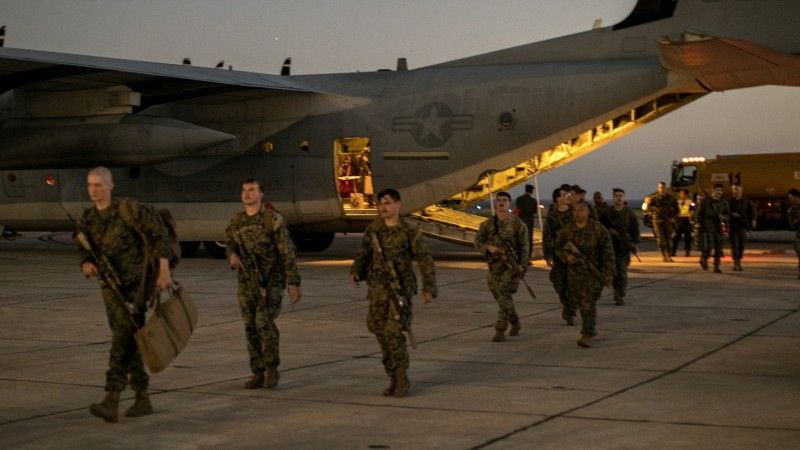
At the center of this reinforcement are two Marine Expeditionary Units (MEUs). The 11th MEU, consisting of around 2,200 Marines, departed from San Diego aboard the USSBoxer, while the 31st MEU, of comparable size, is deploying aboard the USSTripoli. These units provide Washington with a flexible operational toolkit, capable of both conducting air strikes and amphibious operations, as well as rapid-response missions and disaster relief across multiple domains.
Mixed signals
President Donald Trump said Thursday: „No, I’m not putting troops anywhere,” when asked whether he intends to send more service members to the region; a mixed signal given recent developments in the region. Alternative pathways for managing the conflict are also being explored, including efforts to secure maritime routes through the Strait of Hormuz and the consideration of limited strikes against Iran’s critical energy infrastructure, notably Kharg Island, which accounts for approximately 90 percent of the country’s oil exports.
Recent developments suggest that U.S. decision-making is increasingly constrained by energy considerations rather than purely military logic. Limited flexibility in the enforcement of sanctions on Iranian oil exports indicates that Washington is attempting to avoid further disruptions to global supply, particularly in the context of instability around the Strait of Hormuz, which remains a critical chokepoint for global energy flows. This highlights a structural constraint: escalation against Iran cannot be detached from its impact on energy markets.
At the same time, Iran is expanding its deterrence posture beyond the immediate region. The demonstrated range of its ballistic missile systems, assessed at up to approximately 4,000–4,800 km, extends potential strike capabilities beyond the Middle East, including toward parts of Europe. This significantly alters the strategic context, as Iranian capabilities are no longer limited to regional deterrence but increasingly affect broader security calculations.
From this perspective, U.S. actions should be understood as an attempt to preserve operational flexibility across multiple domains. The combination of naval presence, air capabilities and forward-deployed Marine units allows Washington to respond to a range of scenarios, from maritime security operations to limited strikes, without committing to full-scale escalation.
Domestic constraints further complicate the strategic picture. Public support for deeper involvement remains limited, while the administration is reportedly preparing a supplemental funding request of up to $200 billion, suggesting expectations of a prolonged campaign.
Will there be a ground invasion?
Recent assessments suggest that potential U.S. ground operations in Iran, while technically feasible, would be resource-intensive. According to former CENTCOM commander Gen. Joseph Votel, even a limited operation such as seizing Kharg Island would likely require a battalion-sized force of approximately 800–1,000 troops, coupled with sustained logistics, air cover, and force protection.
More ambitious objectives, such as securing Iran’s enriched uranium stockpiles, would represent a significantly larger undertaking, potentially involving brigade-level deployments of 1,000 to 4,000 troops, alongside Special Operations Forces, persistent ISR, and dedicated air superiority. Crucially, such operations would not be short, surgical raids, but rather prolonged and vulnerable missions requiring a robust logistical tail and continuous protection, and likely protracting the ongoing conflict.
From this vantage point, Washington is more likely to pursue a phased approach combining maritime control operations in the Strait of Hormuz to secure essential trade lines, continued air and missile strikes, and selective, limited ground actions. There are high operational risks associated with boots on the ground and the broader strategic constraints, including force readiness, munitions stockpiles, and global commitments. Therefore the deployment of additional Marines does not, in itself, determine the guarantee of a ground invasion. It does, however, expand the range of options available to Washington, and with it, the risk that those options will eventually be used.
From this perspective, the key variable for Washington is time. A prolonged disruption in the Strait of Hormuz is not an acceptable scenario. The United States is unlikely to tolerate a situation in which the strait remains effectively blocked for months. The priority for the Trump administration is to stabilize the situation and bring the current phase of operations in the Strait of Hormuz to a close no later than mid-April.
Authors: dr Aleksander Olech, Karolina Kisiel


