- KOMENTARZ
- WAŻNE
- WIADOMOŚCI
The U.S. is sharply reducing its presence in NATO

The Americans are not leaving NATO completely, but they are withdrawing from centres in which the Alliance and its partners organise exercises, conduct analyses and prepare for future crises and wars. Although this may look less spectacular than a reduction of troops, it will have enormous consequences for Europe.
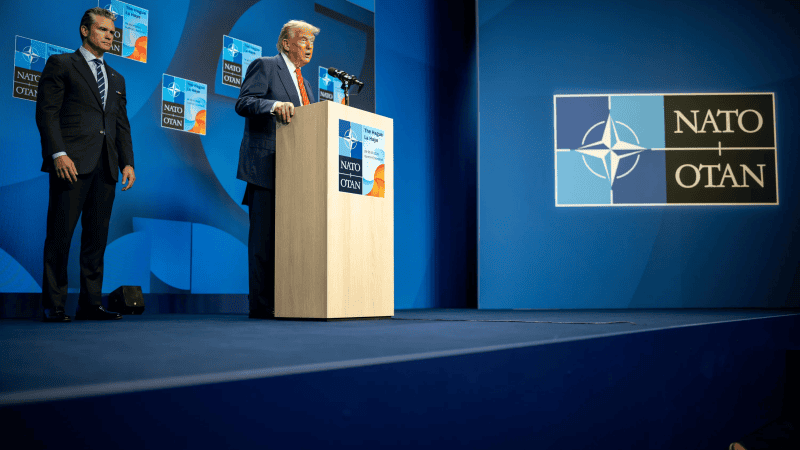
Photo. The White House
The Americans are co-founders of NATO and for decades have remained one of the most important states in the Alliance. Not only in the military dimension, but also politically, in terms of expertise, training and analysis. That is why the decision to withdraw US representatives from a dozen or so NATO Centres of Excellence has greater significance than ordinary personnel changes or suspended rotations.
Originally, the decision was to concern all NATO centres around the world, but ultimately the Americans decided to leave a dozen or so of them, including in Europe. They will not have their representatives there, mainly military personnel. This means less American presence where NATO conducts exercises, prepares analyses, creates scenarios and builds capabilities for future wars and crises. Importantly, in the decisive majority of cases, the projects being implemented concern rivalry with the Russian Federation.
NATO Centres of Excellence — according to the official definition — are specialised, multinational expert centres accredited by NATO (30 Centres), which have very specific tasks: training leaders and specialists, developing doctrines, drawing lessons from operations and exercises, strengthening interoperability and testing new concepts of action. They are not part of NATO’s command structure and are not financed directly by the Alliance, but by framework and sponsoring nations. Their key importance lies in the fact that they provide NATO and its partners with knowledge in areas that today determine security in the global dimension, including cyber defence, counter-intelligence, energy security, counter-terrorism and countering improvised explosive devices, through air and missile defence, maritime operations, air operations, command, military engineering, military medicine, logistics and space, to strategic communication, civil-military cooperation and crisis management.
As I have observed many times, it is precisely in these centres that analyses are created, exercises are conducted and procedures are tested which later influence the practical and theoretical preparation of the Alliance for crisis, war and hybrid attacks.
This year, the Americans are to reduce around 200 posts in NATO structures, primarily by not replacing personnel after rotations end. This concerns not only selected commands or coordination structures, but also some expert groups and precisely the Centres of Excellence. The number itself does not have to make a great impression if compared with the total US presence in Europe. The problem is that we are talking about experts, often military ones, working in places where the Alliance thinks, plans, exercises and prepares for future challenges.
Exercising for war
I wish to point out that these centres are crucial, because I myself have taken part in exercises and simulations conducted in similar formats in a dozen or so NATO centres around the world. For example, I participated in exercises with Ukraine which lasted nearly a year and involved Ukrainian military personnel and decision-makers, and one of their most important summaries was the activity carried out in September and October 2021 in Odesa. They concerned Russian attacks on Ukraine’s energy infrastructure, scenarios of hybrid pressure, disruptions to supplies and the state’s response to crisis.
After the Russian aggression in February 2022, it turned out that the scenarios we had prepared proved accurate in more than 80 per cent. This demonstrates that such exercises are not theory for the sake of theory, but prepare states — and the entire Alliance and its partners — for situations which later really do take place.
In this connection, the Americans« departure from these structures is not just a matter of money and the absence of a representative. I assess it as the absence of an American voice in exercises, the absence of American experience in studies, the absence of joint analyses, the absence of participation in simulations and the absence of the daily building of cooperation in specific states. The Americans are taking their specialists away, and with them part of the knowledge, procedures, institutional memory and political weight about which so much has been said in Europe for months. NATO centres will continue to operate, but without the US their significance, especially for partner states, will be weaker.
It is already known that the Americans are withdrawing, among others, from the Defence Against Terrorism Centre of Excellence in Ankara (DAT COE) and from the NATO Energy Security Centre of Excellence in Vilnius (NATO ENSEC COE). The latter is particularly important for our part of Europe. Energy security, after Russia’s aggression against Ukraine, has become one of the main elements of state resilience — and if we add to this the crisis in the Middle East, we have enormous challenges. If NATO is to understand how Russia strikes at energy, critical infrastructure, transmission networks and societies through energy pressure, then such a centre is of fundamental importance.
America with a plan of withdrawal
It must also be remembered that this process did not begin today. The Americans had earlier withdrawn from a number of international organisations and formats, and in the context of security, the departure from the European Centre of Excellence for Countering Hybrid Threats in Helsinki (Hybrid CoE) was particularly important. This is not a NATO centre, but a format cooperating with NATO, and it is very important for analysing Russia’s hybrid activities. This shows the direction: the Americans are not closing structures in Europe, but are reducing their own presence in them as much as possible. Europe is left with NATO institutions, but without the American expert at the table.
It is also fundamental that NATO centres operate not only with member states of the Alliance. They also invite and train Ukraine, Moldova, the states of the Caucasus, Armenia, Azerbaijan, countries of Africa, the Middle East and partners from the Indo-Pacific, including South Korea, Japan, Australia and Singapore. These are places where NATO builds capacity on a global scale. It is there that partners learn procedures, get to know the Alliance’s way of thinking, exercise with NATO states and move closer to Euro-Atlantic structures. The absence of Americans in such exercises means not only a smaller military contribution, but also a limited political, diplomatic, financial and generally cooperative dimension.
NATO has many such centres and is developing further areas. Recently, a centre concerning the organisation of a Centre of Excellence for artificial intelligence was undertaken. As emphasised above, there are centres connected with energy security, cyber, climate, terrorism, special operations, logistics, medicine, military police and counter-intelligence. This shows that for years the Alliance has been building expert mechanisms which the European Union is only beginning to learn.
Who will lead?
The EU is considering creating its own centre modelled on NATO Centres of Excellence. One of the ideas is to establish a European Security and Defence Council. Apart from that, in working terms one can speak of a European Security Institute or a European Security Centre. Such an institution could gather EU states, prepare analyses, scenarios, reports and exercises. The difference is that NATO has had this architecture and know-how for years, while the Union is only beginning to build it. The Alliance is present in several dozen states, while the EU will begin with a format in Brussels.
In a month’s time, the NATO summit will take place in Türkiye and perhaps President Trump will still correct some of the decisions. I would not assume, however, that the whole process will be reversed. Decisions on withdrawing Americans from some centres have already been made and are being implemented. This fits into the broader policy of the Trump administration, which wants Europe to take greater responsibility for its own security, while the United States retains freedom of action towards the Indo-Pacific, the Middle East and its own internal priorities.
This is no longer about a formal US departure from NATO. Now it concerns limiting the American presence in places where the Alliance prepares for future crises and wars. This is less visible than the rotation of a brigade or the presence of fighter aircraft, but it is still very important. Expert centres create analyses, conduct exercises, build scenarios and teach states how to react before war occurs. If the Americans withdraw specialists from these structures, Europe loses part of American experience, knowledge and political weight.
For Poland, the Baltic States and Eastern Europe, this should be — yet another — warning signal. Countries that have so far been less engaged must enter international formats more strongly, increase their own presence in NATO centres and build competences which until now were often provided by the Americans. The US will remain the most important ally, but it will no longer be automatically present everywhere Europe would like to see it.
Russia sees, assesses and exploits such gaps very well. Therefore, the answer cannot be to complain about Washington and wait for Paris, Ankara or London to come, but to increase European activity in structures around the world which prepare NATO and the Allies for war, crisis and hybrid activities.