- WIADOMOŚCI
- WAŻNE
- ANALIZA
North Korea as the main foe?


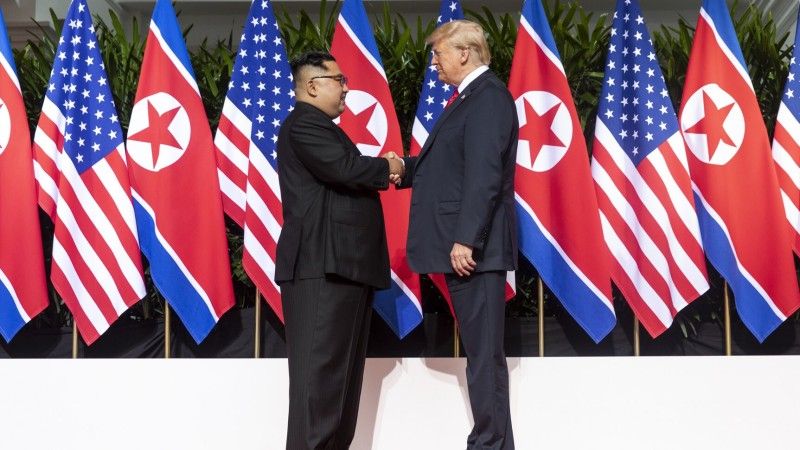
Photo. White House Photos / X
The United States has kept its communication channels open — even with its most apparent adversaries. Yet North Korea remains the sole exception.
The United States has not broken diplomatic engagement in the context of either Ukraine or the Middle East. Quite the opposite — Washington has kept virtually all communication channels open. Even shortly before the outbreak of the war with Iran, negotiations with Tehran were ongoing. This clearly shows that the United States operates simultaneously on diplomatic and military tracks. It is not a contradiction, but a consistent approach: maintain dialogue, even with adversaries, while being fully prepared to escalate if necessary.

North Korea: the one closed channel
The only exception to this approach is North Korea. Here, the situation is fundamentally different. Within the Pentagon, in line with the White House, there is a clear assessment that any hostile move by Pyongyang would trigger an immediate and significantly stronger response than what has been seen in the case of Iran. North Korea is currently viewed in a distinctly negative way by the Trump administration, and there is no functioning diplomatic platform. Donald Trump, who in the past was one of the first leaders to engage directly with Kim Jong-un, is no longer interested in rebuilding that relationship. This channel has effectively been closed.
The closure of the U.S.–North Korean channel is taking place alongside renewed Chinese engagement with Pyongyang. Xi Jinping’s latest visit to North Korea, his first in nearly seven years, showed that Beijing does not intend to leave its relationship with Kim Jong Un entirely in Moscow’s hands. North Korea is strengthening its military cooperation with Russia, but for China it remains an important instrument of influence on the Korean Peninsula and a key element of regional competition with the United States. As a result, the absence of dialogue between Washington and Pyongyang may push North Korea even closer to both China and Russia.

As a result, while the United States remains engaged in managing the war in Ukraine and conducting operations in the Middle East, North Korea is increasingly perceived as one of the key threats. What stands out in Washington is the growing emphasis that if North Korea were to escalate its nuclear programme, the United States would be ready to respond not only conventionally, but also at the nuclear level. This clearly differentiates North Korea from other actors such as Iran — where dialogue remains possible — and shows that the current U.S. strategy is selective, pragmatic, and based on prioritising threats rather than treating all adversaries in the same way.
Increasing assertiveness, losing stability
As a result, while the United States remains engaged in managing the war in Ukraine and conducting operations in the Middle East, North Korea is increasingly perceived as one of the key threats. What stands out in Washington is the growing emphasis that if North Korea were to escalate its nuclear programme, the United States would be ready to respond not only conventionally, but also at the nuclear level. This clearly differentiates North Korea from other actors such as Iran — where dialogue remains possible — and shows that the current U.S. strategy is selective, pragmatic, and based on prioritising threats rather than treating all adversaries in the same way.

The current U.S. posture towards North Korea represents a conscious trade-off between a more assertive policy towards North Korea at the expense of reduced crisis stability. Given that the Korean Peninsula remains one of the world’s most volatile potential flashpoints, and with sustained American engagement across the broader Indo-Pacific region, this lack of transparency threatens to exacerbate tensions should escalation occur. The critical question, however, is whether Washington would even consider diplomatic engagement if Pyongyang crosses established red lines, and the truth is that American diplomatic patterns to date offer little evidence of such flexibility.