



- WIADOMOŚCI
- ANALIZA
Narva and Klaipėda in Putin’s crosshairs?

In recent months, reports have increasingly made their way into the media about an alleged intent to establish the „Klaipėda People’s Republic” and the „Narva People’s Republic.” Is Russia planning to implement in Lithuania and Estonia a scenario similar to the one it pursued in Ukraine several years earlier?
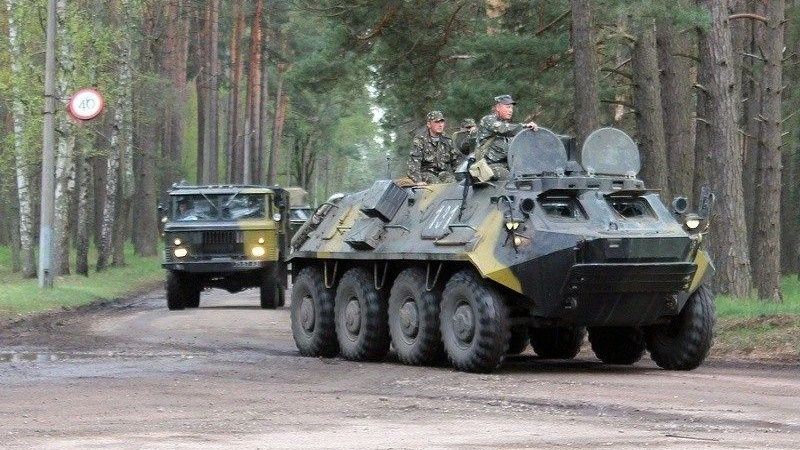
The intensification of content suggesting a risk of the creation of „independent” republics on the territory of the Baltic states raises several important questions. What is the purpose of publishing such reports? And who is the campaign primarily aimed at?
Why Narva and Klaipėda?
The appearance of reports about potential tendencies toward the separation of Narva or Klaipėda does not come out of nowhere. In both cases, a significant role could be ascribed to demography and historical factors. „As a result of Soviet settlement policy, the ethnic profile of these cities has changed. Today, they are inhabited by Russian speakers. Importantly, in Klaipėda around one-fifth of residents are of non-Lithuanian nationality. Narva is, in essence, practically a Russian-speaking city,” Bartosz Chmielewski, an expert responsible for the Baltic Project at the Centre for Eastern Studies, told us.
Overzealousness or a justified stance?
Being aware of the demographic background of the areas in question, we can now move on to who exactly is exploiting them to create disinformation campaigns. A recent article published by the Estonian outlet Eesti Ekspress points us in a certain direction here. It reads that among those disseminating separatist-inciting content in Narva are radical Russian neo-Bolsheviks (specifically, the National Bolshevik Movement — ed.).
Noteworthy, the Estonian media outlet mentioned above is not the only entity exposing the activity of groups amplifying narratives about supposedly growing independence tendencies in Narva or the Lithuanian city of Klaipėda. According to Bartosz Chmielewski of the Centre for Eastern Studies, this fact shows that both Lithuania and Estonia are appropriately monitoring and responding to such disinformation campaigns. At the same time, as he noted, their reaction can sometimes be overly exaggerated.
„In my view, the fairy tales about »people’s republics« in the Baltic states attract more interest from European media than from the communities to which they are addressed,” he argues, stressing that Russian disinformation operations will probably not stop at these two regions. „In the future, more fan pages of »people’s republics« will emerge. The creation of virtual separatist republics in the Baltic states by Russian propaganda has been ongoing for more than a decade. Only the methods of communication have changed,” he added, citing the example of 2008, when leaflets calling for the creation of autonomy were distributed in Narva, and after 2015 the effort moved online, where fan pages of such virtual republics as Vilnius, Latgalia, and Baltic-Russian began to appear.
Does the creation of „virtual people’s republics” mean that real political entities will follow? According to Bartosz Chmielewski, not necessarily. „Regardless of the fact that more »virtual people’s republics« may emerge in the future, real separatism in Narva, Klaipėda, Vilnius, or Latgalia does not exist,” he says, recalling that attempts to establish autonomy in the Baltic states did in fact take place, but this occurred in the early 1990s out of fear of political and economic transformation in Estonia or Lithuaniization in the Vilnius region.
Ukrainian scenario as a possible course of events?
Coming to a conclusion, another important question arises. Can today’s Russian (dis)information campaign be part of creating the „groundwork” for a more serious, large-scale military operation? We still remember the events of May 2014, when pro-Russian separatists in Ukraine proclaimed the creation of the Luhansk and Donetsk People’s Republics, as well as February 2022, when Vladimir Putin signed a decree recognizing the „people’s republics” in Donbas, which became the trigger for the launch of the „special military operation,” that is, the war in Ukraine.
Bartosz Chmielewski notes that the current situation in the Baltic states is difficult to compare with what was happening in Ukraine in 2014. „The events in post-Maidan Ukraine are incomparable to the »virtual republics« appearing in online space. Lithuania, Latvia, and Estonia are not states wracked by political revolution, like Ukraine at the time. Moreover, Estonia and Lithuania are countries where the state apparatus is more efficient than Ukraine’s was more than a decade ago. Any manifestations of externally organized separatism would be met with a response from the security services of the Baltic states,” the analyst said.
„The Baltic states have been the target of Moscow’s imperial policy for more than 3 decades now. As I emphasized above, insinuations about »people’s republics« have been appearing regularly for several years, but so far they exist only on the Internet. At present, there is little to suggest that Russia is mobilizing forces along the borders of Estonia or Latvia. It appears that, with such significant involvement in the fighting in Ukraine, Moscow has limited capacity for a successful intervention in the north. This does not mean, however, that Russia has no plans to attack the Baltic states (…)” he continued, adding that in this specific case the 2022 scenario is more likely than the 2014 one.
„Narva or Klaipėda, or any other city in the Baltic states, will not become a »second Crimea«; in the darkest scenario, they are more likely to share Mariupol’s fate,” he concluded.


