



- ANALIZA
- KOMENTARZ
- WIADOMOŚCI
Limiting Ankara: European Parliament targets Türkiye’s role in future EU defence projects

The European Parliament’s Security and Defence Committee (SEDE) has taken one of the most significant steps in recent years to limit Türkiye’s participation in European defence projects. The amendment, adopted by a vote of 29 to 5, with one abstention, excludes Ankara from the defence components of the new Horizon Europe programme for 2028–2034.
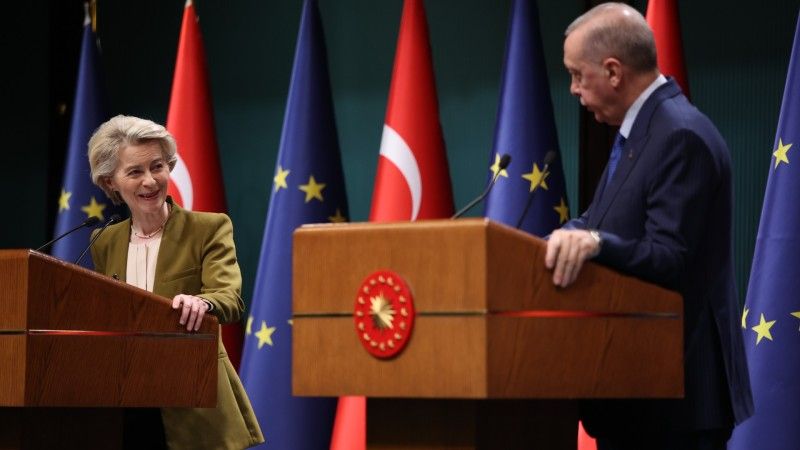
Photo. European Commission official website
The vote itself, however, does not mean Türkiye’s complete exclusion from Horizon Europe. Formally, it refers only to one stage of the EU’s decision-making process and not to a final decision. This is an important distinction, as media outlets—particularly some Turkish and Greek media—have begun publishing headlines suggesting Ankara’s complete “exclusion” from the program. In reality, the amendment applies only to future projects related to defence, security, and dual-use technologies. Türkiye remains a participant in the civilian parts of the program, including science, health, climate, digital technologies, and industrial research.
Politically, however, this vote has a much broader significance. It demonstrates that Europe is increasingly facing two competing visions of relations with Türkiye. One sees Ankara as an often difficult but absolutely essential strategic partner, while the other sees it as a country that must be kept out of the strategic and, therefore, most sensitive areas of the future European security architecture.
At the same time, it should not be forgotten that the European Union as a whole is currently under increasing pressure to build its own military and industrial capabilities. The Russian-Ukrainian war, concerns about the durability of US security guarantees, and the renewed discussion of “strategic autonomy” are prompting EU member states to increase military spending and develop new instruments, such as the Security Action for Europe program and plans for the rearmament of Europe.
The SEDE vote thus demonstrated that, although the European Union is increasingly talking about the need to build its own strategic autonomy, it remains unable to answer a fundamental question: should Türkiye be part of this new security architecture, or rather an external partner used only when it suits the member states.

What was actually passed?
The adopted amendment, proposed by Cypriot MEP Costas Mavrides (a member of the Progressive Alliance of Socialists and Democrats), limits Türkiye’s participation in the defence components of the future Horizon Europe programme for 2028–2034. It was supported by a resounding majority: 29 votes in favour, 5 against, and one abstention. Politically, this was not merely a symbolic gesture, but a serious signal that there is strong support in the European Parliament for a more restrictive approach towards Ankara in the area of security and defence.
However, as mentioned above, this does not mean that Türkiye has been “thrown out” of the entire Horizon Europe programme. The controversial amendment concerns only that part of the future programme, which is intended for the first time to include a greater number of projects related to defence, security, and dual-use technologies.
This distinction is of paramount importance. It is not about completely cutting Turkey off from European research cooperation, but rather an attempt to exclude it only from the most strategic and politically sensitive segment of that cooperation. This detail determines how the entire matter should be interpreted. It is part of the dispute over the future shape of European defence instruments, not a complete severance of research and development relations between the EU and Türkiye.

Why has Horizon Europe suddenly become so important?
Just a few years ago, a dispute over the rules for third-country participation in research programmes would have attracted little attention outside narrow circles of experts and officials. Today, the situation is different because Europe itself has changed. The Russian-Ukrainian war, growing uncertainty about long-term security guarantees from the United States, and the rising costs of rebuilding its own military capabilities have led to intensified discussions in Brussels about the need for strategic autonomy and a more integrated European defence policy.
In this new security landscape, research and innovation are becoming part of a broader power politics. Military technologies, unmanned systems, artificial intelligence, cybersecurity, satellites, reconnaissance, battlefield electronics, space technologies, and dual-use projects are no longer neutral areas of cooperation, but the core of future strategic advantage. This means that the question of who can participate in such programmes is becoming a strictly political one.
While the exclusion of certain non-EU countries from the project may be controversial, it is important to remember the reasons behind it. The EU has greater influence over its member states and, if necessary, can effectively restrict or encourage them to adopt specific domestic and foreign policies. However, in the case of third countries, this leverage remains more limited, which may ultimately lead them to focus solely on their own national interests and retain the ability to change their policy direction. This, in turn, carries the risk of investment without a guaranteed return.
That’s why extending the defence logic to the new version of Horizon Europe is so crucial. If defence is to be included in one of the EU’s most important research and innovation funding programmes, a dispute over access criteria automatically arises.

Türkiye as an indispensable, yet politically uncomfortable partner
Turkey occupies a unique position in the European system, and its importance to European security is constantly growing, particularly in the context of a weakening transatlantic partnership. Ankara possesses the second-largest army in NATO and controls a strategically important location between Europe, the Middle East, the Black Sea, and the Eastern Mediterranean. Furthermore, over the past decade, it has significantly expanded its defence sector. Turkish defence exports were expected to exceed $10 billion by 2025. Turkish companies supply drones, missile systems, ships, combat vehicles, and electronic solutions, which are increasingly seen as an attractive alternative to the costly and slow-paced projects implemented in Western Europe. From a purely military and geostrategic perspective, its importance for Europe is unquestionable, as confirmed during NATO Secretary General Mark Rutte’s visit to Ankara, Türkiye (21–22 April 2026).
The problem, however, is that Türkiye’s relations with the European Union have long been structurally at odds. Formally, Ankara remains a candidate country for membership. In practice, the accession process was frozen, which caused frustration on the Turkish side, especially given that Türkiye did not receive visa-free access to the Schengen Area. This distinguishes it from, for example, the United Arab Emirates, which gained full visa-free access to the Schengen Area on May 6, 2015, as well as from citizens of Bahrain, Oman, and Saudi Arabia. Although the latter do not yet enjoy full visa-free travel, they have been able to obtain multiple-entry Schengen visas valid for up to five years from the initial application since April 2024.
Therefore, it is clear why Türkiye’s partnership with the EU is becoming increasingly transactional. After the 2015 migration crisis, Turkish-EU relations have largely been based onad hoc agreements and the exchange of benefits rather than on genuine political convergence. While this model could work for a time, it has proven insufficient in the field of defence.
Security and defence require trust, predictability, joint planning, and at least a minimum level of strategic alignment. The SEDE decision thus reveals a fundamental paradox in European policy towards Türkiye. On the one hand, the European Union needs its military and industrial potential more than it did just a few years ago. On the other hand, political disputes with Ankara—for example, over Cyprus, the Aegean Sea, the Eastern Mediterranean, the rule of law, and President Recep Tayyip Erdoğan’s foreign policy—have led some member states to exclude Türkiye from the most sensitive security-related projects.

Europe needs Turkish capabilities more than it cares to admit.
For some EU countries, especially those seeking more flexible industrial partnerships, Türkiye appears to be a valuable partner, as evidenced by successive public procurement contracts and joint projects. In a world where many European arms programs are costly, slow, and burdened by internal political disputes, the Turkish sector offers speed, scale, co-production opportunities, and growing interoperability with NATO solutions. From this perspective, Ankara’s complete exclusion from areas related to defence capability development seems striking – though understandable, given the balancing and sometimes even provocative style of Turkish foreign policy.
Cyprus, Greece, and the logic of Ankara’s political blockade
The situation is perceived quite differently by states and political actors, who primarily view Türkiye through the prism of regional conflicts and disputes over international law. The Greek and Cypriot delegations have played a key role here.
Politicians from these countries have for years sought to portray Türkiye as acting contrary to the principles of good neighbourliness and its own interests, which they equate with the interests of the entire EU. Various provocative declarations from both sides (e.g., Erdoğan’s famous “We might arrive suddenly one night”) regarding the undermining of border status and the militarization of the islands have also contributed to this.
Moreover, Costas Mavrides’s arguments have been recurrent in the context of the Turkish military presence in Northern Cyprus, disputes over exclusive economic zones in the Mediterranean, and Turkey’s “Blue Homeland” doctrine (Turkish:Mavi Vatan), which the European Parliament has also criticized in its latest report on Turkey.
However, the differences in perspectives among EU member states are clear. Some countries—primarily the aforementioned Greece and Cyprus, but also France and Austria—view Türkiye primarily through the prism of political disputes, the rule of law, and regional tensions. Others—particularly Spain, Italy, and, to some extent, Germany—are beginning to view Ankara more pragmatically, as an indispensable partner for European security.

Does the SEDE vote reflect the EU's long-term political direction?
This question is more important today than the vote itself. The SEDE Committee does not make final decisions for the entire EU, but rather guides the political debate. If the Committee’s opinion is later reinforced by other European Parliament bodies in subsequent stages of the procedure and reflected in broader budget negotiations, this could lead to the institutional entrenchment of a more restrictive approach towards Türkiye in security matters.
At the same time, there is no guarantee that this will happen. The EU legislative process is long, multi-stage, and subject to negotiation. Not only will the positions of political groups in the Parliament be important, but also the interests of the Member States, the position of the European Commission, and the broader geopolitical context. In other words, today’s vote sends a strong signal, but it does not yet constitute a final decision.
Türkiye has already responded, emphasizing that reports of a complete exclusion are false and that the talks concern only certain elements of the future program. Nevertheless, Ankara recognizes that in the current situation, the political interpretation of the legislation is as important as its provisions. Perpetuating the perception that Türkiye has been sidelined from the European strategic project could have consequences beyond Horizon Europe.
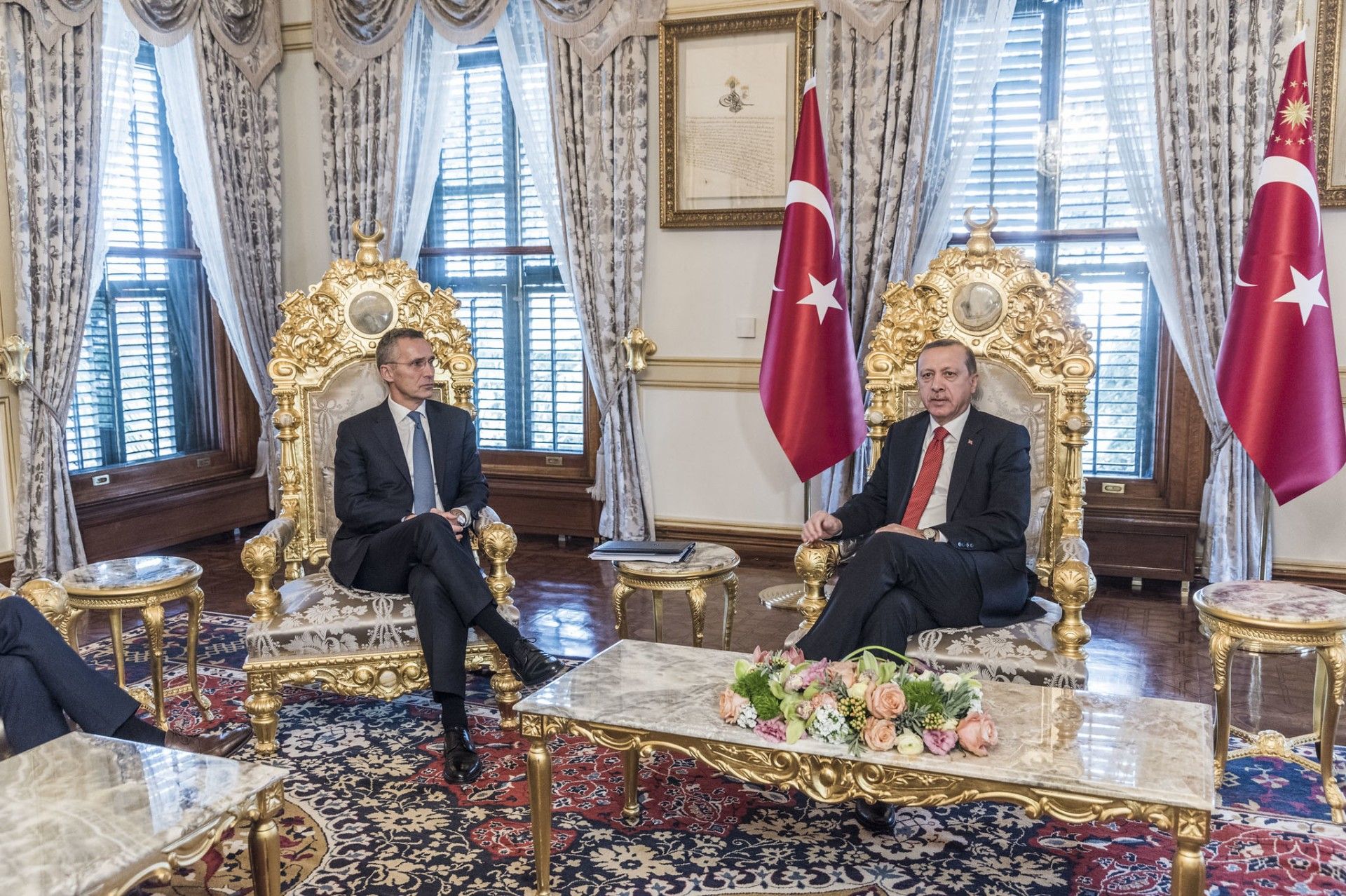
Beyond Horizon Europe: The broader issue of Türkiye's access to the European Defence Architecture
The dispute over Horizon Europe also fits into a much broader pattern. Türkiye has for some time signalled its ambition to play a key role in the evolving European security architecture. This applies not only to industrial cooperation with individual states, but also to access to new EU instruments, such as the Security Action for Europe (SAFE), and other mechanisms supporting collective defence capabilities.
The problem is that the political blockade against Ankara is beginning to take on a structural form. Türkiye is a NATO member, associated with some areas of EU cooperation, and one of the most important security actors in the region, yet it is regularly excluded from the most prestigious, strategic, and financially significant mechanisms being built by the EU. This phenomenon is causing growing frustration on both sides. For Türkiye, it represents a lack of recognition of its role. For some EU member states, it is a way to maintain political pressure on Ankara.
The result is a relationship model that is difficult to consider stable. Europe wants to leverage Türkiye’s potential, but it refuses to give Ankara a full seat at the negotiating table. Türkiye wants to be treated as a strategic partner, but it refuses to accept conditions it considers politically discriminatory. The Horizon Europe programme is just the latest example of this structural conflict.
The Biggest Paradox: Europe wants Turkish power, not Turkish presence
The European debate on strategic autonomy has not yet been fully resolved. Strategic autonomy means more than just increasing budgets and creating new instruments. It also requires answering the question of with whom Europe wants to build its future strength. If the answer is limited to partners who are entirely politically unproblematic, the EU’s room for manoeuvre may prove much narrower than its leaders suggest. However, if Europe is to be guided primarily by security interests, it will have to learn to cooperate with difficult partners—often not fully aligned with its operational model, yet indispensable.


