



- WIADOMOŚCI
- ANALIZA
Italy and the Iranian oil crisis: strategic vulnerability in the Central Mediterranean

A cascade of disruptions from the Strait of Hormuz to North Africa is testing Italy’s structural dependence on imported energy and exposing the gap between Rome’s diplomatic agility and its long-term strategic resilience.
The closure of the Strait of Hormuz following the American and Israeli military campaign against Iran has put Italy back in a familiar position. Rome remains dependent on energy flows it cannot control, and on diplomatic relationships that have to be maintained before a crisis, not improvised during one.
Italy generates approximately 44% of its electricity from natural gas, well above the EU average, and imports most of the energy it consumes. The 2026 crisis has therefore not created a new Italian problem. It has exposed an old one under pressure.
For Rome, the issue is not only the physical interruption of supplies. It is the speed with which an external shock moves through the national system, from tanker routes and LNG contracts to gas benchmarks, electricity prices, airport fuel stocks and road transport costs. The first weeks of the crisis showed that Italy has instruments to manage pressure. They also showed that most of those instruments are tactical.
For Italy, the Mediterranean is not a strategic environment in the abstract. It is the physical space through which energy, migration, maritime security and industrial competitiveness are connected. The Iranian crisis has made that connection visible again.
The structural exposure
Since late February 2026, the near-closure of the Strait of Hormuz has disrupted one of the world’s most important energy corridors. Under normal conditions, the Strait handles a substantial share of global oil and LNG trade.
Italy’s exposure is not primarily a function of direct dependence on Hormuz-transiting crude. The transmission mechanism runs through price formation, LNG availability and replacement costs. Qatar normally provides around 10% of Italy’s annual gas needs.
After Iranian strikes damaged Qatari LNG infrastructure, QatarEnergy extended force majeure and Italian buyers were reportedly notified that several cargoes scheduled for the spring would not be shipped. Because gas remains central to Italian power generation, the impact moves quickly through the electricity system.
The macroeconomic effect is not marginal. Higher energy prices put pressure on households, industry and public finances at the same time. In a country with high public debt, energy-intensive manufacturing and limited fiscal space, import dependence stops being an abstract strategic concern. It becomes a budget problem within a single quarter.
Operational symptoms appeared within weeks. Airports in Milan Linate, Bologna, Venice and Treviso issued fuel-supply restrictions or advisories after a delayed Air BP cargo created a temporary jet fuel shortage. The disruption was contained by local suppliers and flight operations were not seriously affected, but the episode still mattered. Petrol and diesel prices moved above the politically sensitive threshold of €2 per litre in several areas. The government responded with a temporary excise-duty cut, while transport associations increased pressure through strike threats and local assemblies.
This did not amount to a collapse of the system. It did, however, show how little operational margin Italy had in some parts of the supply chain.

A diplomatic campaign in two stages
Rome’s response has relied on existing bilateral relationships, each with a different function. Algeria is a pipeline partner with decades of institutional depth. The Gulf states are LNG suppliers, investment partners and political interlocutors. In the Gulf, Rome combined the energy file with a political message: support for partners targeted by Iran, without direct Italian military involvement.
On 25 March, Prime Minister Giorgia Meloni travelled to Algiers for her second official visit since taking office, meeting President Abdelmadjid Tebboune. The visit had been scheduled before the full effects of the crisis were visible. Its political weight changed after the disruption of Qatari LNG deliveries.
Algeria has become Italy’s most important pipeline gas supplier, accounting for roughly 30% of annual consumption through flows connected to the TransMed pipeline. Bilateral trade reached €12.9 billion in 2025, and Italian direct investment remains substantial.
The relationship between Eni and Sonatrach, rooted in cooperation dating back to Enrico Mattei’s industrial legacy, gives the partnership a depth that newer supplier relationships do not have.
Meloni and Tebboune agreed to work on additional areas of energy cooperation, including offshore and deep-sea gas exploration, and to strengthen the institutional architecture of bilateral trade through an Algerian-Italian Chamber of Commerce. Algeria, however, cannot replace Gulf volumes on an emergency timescale. New offshore extraction capacity takes years. LNG capacity is limited. Domestic Algerian demand is rising. In a seller’s market, Algiers has little incentive to offer preferential pricing simply because Rome needs additional volumes.
The European dimension was visible immediately. Spain’s foreign minister arrived in Algiers the following day, pursuing similar objectives through Algeria’s western energy network. The episode illustrated a wider problem: European solidarity exists as a political principle, but gas procurement still reflects national interests, infrastructure asymmetries and supplier leverage.
See also


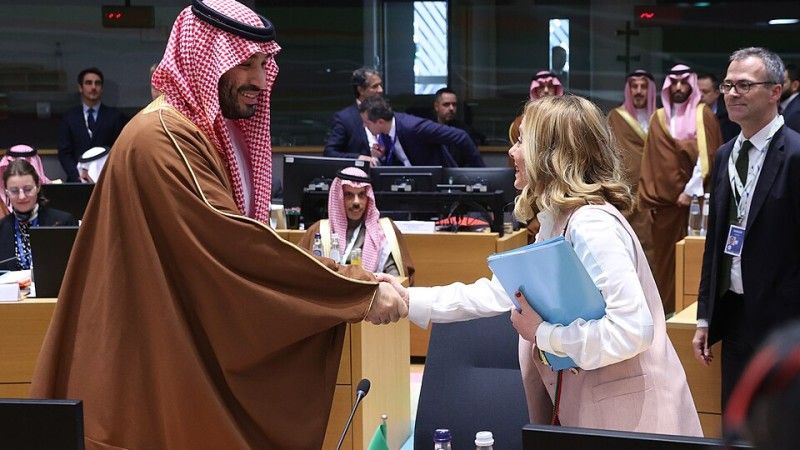
Ten days later, Meloni launched a previously unannounced two-day tour of the Gulf, visiting Saudi Arabia, Qatar and the United Arab Emirates on 3 and 4 April. It was reported as the first visit by a European Union leader to Saudi Arabia since the outbreak of the conflict. In Jeddah, she met Crown Prince Mohammed bin Salman to discuss regional security, ceasefire efforts and energy supply.
In Doha, she offered Italian industrial support for the rehabilitation of Qatari energy infrastructure damaged by Iranian strikes, while freedom of navigation in the Strait was described as an urgent shared priority. In the UAE, she expressed solidarity with Abu Dhabi and acknowledged Emirati assistance in repatriating Italian citizens caught in the region at the start of the conflict.
On 4 May, Meloni travelled to Baku for the first official visit by an Italian prime minister to Azerbaijan in thirteen years, meeting President Ilham Aliyev to consolidate energy supply guarantees and expand bilateral trade. The two leaders agreed to hold a Business Forum in Baku in the second half of 2026, with the aim of deepening commercial and industrial ties; Azerbaijan currently supplies roughly 16% of Italy’s gas needs via the TAP pipeline and 17% of its oil imports.

What the diplomacy has produced
The results should be assessed against what the situation required, not only against what was diplomatically possible.
From Algeria, Italy obtained a framework for expanded cooperation and a commitment to maximise existing pipeline potential. From the Gulf, it secured political goodwill, confirmation of continued Eni engagement and an opening for Italian companies in the rehabilitation of Qatari infrastructure. These outcomes are useful. They do not constitute an immediate supply solution.
No diplomatic agreement can quickly restore damaged LNG export capacity. No offshore exploration project can deliver emergency volumes. No political visit can remove the pricing power of suppliers during a shortage. The most concrete near-term supply development came through commercial channels: Reuters reported that Italy is expected to begin receiving LNG from the Golden Pass facility in the United States from June 2026.
The Mattei Plan gives the Algeria relationship a wider political framework. Two initiatives are already under way: a desert agriculture project with BF International and a training centre in Sidi Bel Abbès intended as a pan-African hub for agricultural expertise. This matters because a relationship based only on gas purchases remains vulnerable to price cycles and supplier diversification. A relationship that includes industrial investment, training and infrastructure is harder to displace.
There is a risk, however, that the Mattei Plan becomes a diplomatic container for projects too small or too slow to alter Italy’s actual energy position. It gives Rome a strategic language. It does not yet give Rome strategic depth at the pace required by the current environment.

The position that has not changed
European gas storage entered the crisis at low levels after a cold winter, with reserves around 30% in late April and the EU already warning that refilling targets may be difficult to meet before next winter. Damage to Qatari LNG infrastructure is expected to weigh on the market for years rather than weeks. Even if the military phase of the crisis de-escalates, energy prices are unlikely to return quickly to pre-crisis levels.
Italy has not been passive. Gas demand has fallen by around 16% since 2021, reflecting efficiency gains, partial renewable deployment and weaker industrial consumption.
At the same time, the Italian response remains constrained by factors that cannot be changed during an emergency. Permitting procedures, grid capacity, storage deployment and local opposition to energy infrastructure all affect the speed at which the country can reduce dependence on imported gas. These are not problems that can be solved by a diplomatic mission, even a successful one.
The sequence of Algiers, Jeddah, Doha and Abu Dhabi helped consolidate Italy’s bilateral relationships and preserved Eni’s position in a region under military pressure. It also confirmed the importance of Rome’s Mediterranean and Gulf diplomacy at a time when energy security, maritime routes and regional stability are increasingly connected.
The crisis therefore does not show that Italy lacks options. It shows that most of its available options operate on different timelines. Diplomacy can secure political access quickly. Commercial contracts can redirect some flows. Infrastructure, renewables and storage require years. The vulnerability lies in the gap between these timelines.
For Italy, the immediate objective is to manage the shock without losing industrial competitiveness or fiscal control. The longer-term challenge is to ensure that the next disruption in the Gulf, North Africa or the wider Mediterranean does not produce the same domestic pressure with the same speed. That remains the central test of Italian energy security.


