



- ANALIZA
- KOMENTARZ
- WIADOMOŚCI
Easier said than done. The US is urging Lithuania to improve relations with Belarus

With Donald Trump’s assumption of the presidency, US–Belarus relations have experienced a revival. The warming of these ties will affect other countries in the region and their relations with Belarus. Until now, these relations have not been of a partnership nature.
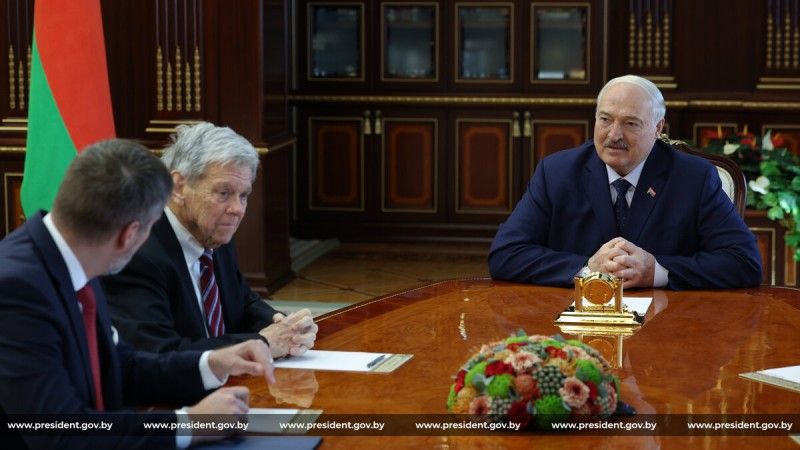
Photo. president.gov.by
Lithuania finds itself in a difficult position. The US Special Envoy for Belarus, John Coale, in an interview with Lithuanian public broadcaster LRT, appealed to the Lithuanian authorities to establish closer contacts with Minsk, particularly in the context of resuming the transport of Belarusian potash fertilizers. “Potash fertilizers from Belarus should be transported through Lithuania, which would open their way to Europe and even to the United States,” Coale said.
Consequences of improved US–Belarus relations
John Coale serves as the US Special Envoy for Belarus. Through his efforts, several Belarusian political prisoners have been released. One such instance was the most recent and largest amnesty on March 19. As a result of talks between the US envoy and Belarusian President Alyaksandr Lukashenka, a record 250 people were pardoned. In exchange for the release of prisoners, the US lifted sanctions imposed on several Belarusian enterprises, banks, and the Ministry of Finance, including the Belarusian Potash Company. Following the amnesty, the number of political prisoners in Belarus dropped below 1,000.
The Trump administration is the first Western government in recent years to decide to renew closer contacts with Belarus. Most European countries have chosen to isolate Lukashenka’s regime, and many actively support the Belarusian opposition led by Sviatlana Tsikhanouskaya.

A meeting between Donald Trump and Alyaksandr Lukashenka is being planned. It has been suggested that it could take place during the next session of the Board of Peace. Belarus did not participate in the Board’s inaugural meeting in Washington in February 2026, despite being invited. The reason for the Belarusian delegation’s absence was the failure of its foreign minister, Maksim Ryzhankou, to obtain a visa. The date of the next Board of Peace session has not yet been set. It would be Lukashenka’s first meeting with a US president in over 30 years of his rule.
“President Trump has made it clear that he is ready to meet with anyone if it serves US interests. Although there are currently no plans for a meeting with Belarusian President Lukashenka, we view this latest prisoner release as another constructive step toward improving our bilateral relations with Belarus. We will continue to assess opportunities for further engagement with Belarus in the future if we see continued progress,” a senior US administration official told the Polish Press Agency. It may appear that the Trump administration is attempting to approach relations with other countries in a purely pragmatic manner; however, by engaging more deeply with one actor, it may risk losing its previously strong position in talks with other partners.

The Lithuanian issue
Belarus borders three European Union member states—Poland, Lithuania, and Latvia. Each of these countries maintains tense relations with its Belarusian neighbor. Particularly strained are the Poland–Belarus and Lithuania–Belarus relations. Both countries support the Belarusian opposition in exile, which seeks to delegitimise Alyaksandr Lukashenka’s regime. Lithuania has maintained a confrontational stance toward Belarus since the rigged elections of August 9, 2020. Following the elections, mass protests erupted across the country, which were brutally suppressed by the authorities. Lithuania was among the first countries not to recognise the election results. Moreover, Lukashenka’s main challenger, Sviatlana Tsikhanouskaya, found refuge in Lithuania.
Between late March and early April, US envoy John Coale appealed to Lithuania to improve relations with its neighbor. The Lithuanian side responded relatively positively but with caution. Lithuanian Prime Minister Inga Ruginienė did not rule out such contact. However, Belarus would first have to meet three conditions:
1. Cease sending smuggling balloons over Lithuania,
2. Allow detained Lithuanian trucks in Belarus to return home without additional fees or penalties,
3. Stop the illegal migration orchestrated by Minsk.
See also


The prime minister emphasised that “we are talking solely about a technical meeting aimed at exchanging positions. It may take place once these conditions are met.” The issue of transferring Belarusian potash fertilizers, however, should be discussed at the EU level. There are concerns that Lithuania’s individual initiative to improve relations with Belarus could provoke a negative reaction from the European Union.
Meanwhile, many Lithuanian politicians are convinced of the need to follow the United States unconditionally. This approach was well explained by political scientist Marius Antonowicz from the Institute of International Relations and Political Science at Vilnius University. It is based on the principle that “if President Donald Trump fights China, then we do too; if Joe Biden focuses on the Indo-Pacific, Lithuania should do the same. Recently, there have been reports that Lithuania is trying to support the Cuban opposition to please Marco Rubio. Such an approach is partly justified, but one must remember that aligning too closely with the US can lead to tensions with Europe. When it comes to sanctions against Belarus, we are primarily talking about EU decisions.” Lithuania has effectively found itself, for the first time, in a situation where it must choose between the US and the European Union, exercising caution not to damage relations with either partner.
In the context of exporting Belarusian potash fertilizers to the West, the Lithuanian port of Klaipėda could play a significant role, as it was previously a key transit point for goods from Belarus. It should be remembered that, at present, every significant move by Minsk is controlled, approved, or directed by Moscow.

The Belarusian opposition’s response
The US appeal was met with a response from the Belarusian opposition in exile. Opposition leader Sviatlana Tsikhanouskaya spoke on the matter during her visit to Vilnius for the celebration of Belarusian Freedom Day. She noted that “Lithuania has become a safe haven for thousands of Belarusians fleeing repression.” In reality, Lukashenka is not interested in improving relations with the West. He merely needs money for repression, the war against Ukraine, and serving Russia. “We are in constant contact with our American partners and ask them not to pressure EU countries, particularly Lithuania, to lift European sanctions,” Tsikhanouskaya added.
The goal of the Belarusian opposition in exile is to overthrow Lukashenka’s regime and hold elections in the country that meet democratic standards. Its political activity is entirely dependent on support from Western partners. In recent years, Belarusian opposition activists have managed to develop a fairly extensive network of contacts with decision-makers in Western countries and international organisations. Nevertheless, the actual agency and influence of this actor on US policy should be viewed with caution.
What should Europe do?
The Lithuanian side has announced that talks with Belarus are being conducted at a technical level. So far, neither side has decided to organise a meeting at the level of deputy ministers or any higher level. The discussions are being held at a technical level, involving relevant services. Lithuania will engage in serious dialogue only after Minsk fulfills the conditions mentioned by the Lithuanian prime minister and demonstrates goodwill.
Discussing a potential revision of relations with Belarus at the EU level could be a sound approach. Within the Union, there has so far been no conflict regarding policy toward Belarus. The EU’s policy of imposing sanctions and isolating the regime has been adopted almost unanimously. Developing a common position would help avoid potential misunderstandings that could arise from a member state individually warming relations with Belarus. Nevertheless, a response from Europe is necessary. At present, the US is conducting talks with Belarus without involving Europe. The outcomes of these talks—such as lifting sanctions on the transport of Belarusian goods to the West—could affect EU member states and become a source of another transatlantic dispute between Europe and the United States.

At this stage, engaging in partnership talks with Belarus is extremely difficult. The country’s authorities remain hostile toward the West. Repressions continue, and political prisoners remain in jails and penal colonies. Pressure on Europe’s eastern border, caused by illegal migration orchestrated from Minsk, persists with varying intensity. Belarusian territory continues to be used by the Russian Federation in its war against Ukraine. All these issues were the reasons for imposing sanctions on Lukashenka’s regime in the first place. Lifting these penalties without prior changes within the country would be an ill-advised and inconsistent move on Europe’s part.


