



- WIADOMOŚCI
Carney’s Indo-Pacific tour tests the promise of middle-power alignment

The Canadian PM launched an Indo-Pacific tour to turn his Davos call for middle-power alignment into a geopolitical force. Will it succeed?
Much has already been said about Mark Carney’s January speech at the World Economic Forum, in which the Canadian Prime Minister argued that middle powers such as Canada must unite in response to increasingly aggressive great powers. His argument offered a fresh and timely answer to the return of great-power politics, in which less powerful states are becoming ever more exposed to pressure, intimidation, and threats from stronger actors. Acknowledging the end of rules-based liberal order, this vision suggests that middle powers can no longer rely solely on established norms and institutions for protection. Instead, they must cooperate more closely, act more strategically, and build new forms of partnerships in order to defend their autonomy and interests in an increasingly hostile international environment.
Yet the crucial question is whether the alignment of middle powers can become more than an attractive strategic concept. This presents a daunting diplomatic challenge, depending on not only a sufficient convergence of interest between them, but also its shared recognition and political willingness to pursue deeper cooperation, which are often far more difficult to achieve. This is why much rests on the shoulders of Mark Carney and whether he can convince his fellow middle powers to buy into the idea and turn it into a practical geopolitical project.
His March Indo-Pacific tour, spanning India, Australia, and Japan, was in many ways an attempt to answer that question in practice. Choosing these middle powers as the destinations of his first diplomatic mission following his Davos speech clearly indicated that forging a „middle powers alliance” had become one of Carney’s top foreign-policy priorities. What links all of these countries is not only their status as middle, yet still potent, geopolitical powers, but also a shared sense of vulnerability. All have recently been exposed to coercive US tariffs and to the risks of excessive dependence on Chinese critical imports. Carney sought to build on these common pressures by appealing to their mutual interest in diversification and resilience, while tailoring his message to each partner’s particular concerns. But did his pragmatic middle-power diplomacy succeed?

Putting middle-power diplomacy to the test in New Delhi, Canberra, and Tokyo
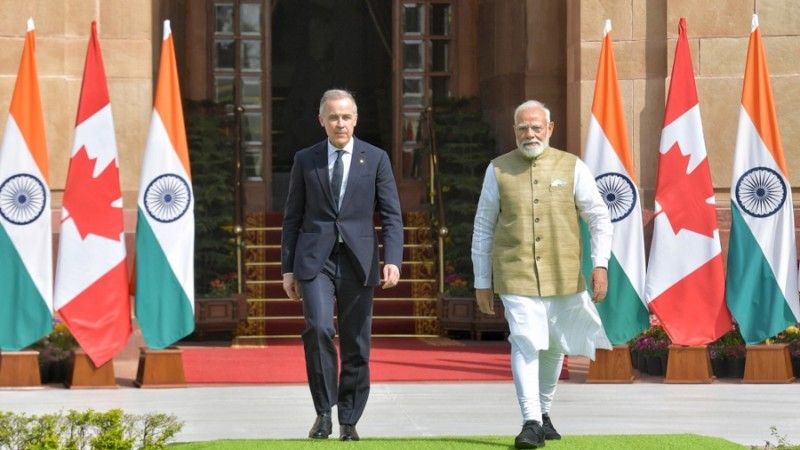
India, Carney’s first destination, offered the clearest example of this logic in practice. The lingering tensions caused by Canada’s accusations of New Delhi’s involvement in the 2023 assassination of a Sikh separatist in British Columbia were put aside, as both governments recognised that shifting international realities made renewed cooperation a strategic necessity. Modi and Carney pledged to finally conclude a free trade agreement after 15 years of negotiations, with the potential to boost bilateral trade from nearly $9 billion in 2024–25 to $50 billion by 2030. They also unveiled a landmark $2.6 billion nuclear deal, under which Canada would supply India with 10,000 tonnes of uranium for its expanding nuclear reactor fleet. Together with agreements in technology, critical minerals, space, defence, and education, these steps suggest that both countries stand to gain substantially from a revitalised relationship.
In Australia, Carney faced a comparatively easier task, as he was addressing a traditional ally with which Canada shares not only core values, but also deep historical and institutional ties rooted in the British legacy and the Westminster system. In his speech to the Australian Parliament, he described Canada and Australia as „strategic cousins” that should work together rather than „let the hegemons dictate outcomes”. Anthony Albanese, his Australian counterpart, likewise spoke in explicitly middle-power terms, showing that this idea was no longer confined to Carney’s own rhetoric, but had entered high-level international political discourse more broadly.
More important than the rhetoric, however, were the concrete measures announced in the joint statement. It laid out a broad agenda for deepened cooperation in strategic areas such as economic security, critical technologies, critical minerals, defence industry, military affairs, and space, supported by the establishment of regular ministerial meetings. Among these, the most significant may be stronger coordination on critical minerals, where both countries are major producers, together accounting for roughly one-third of global lithium and uranium output, as well as more than 40% of worldwide iron ore production. In addition, the two prime ministers confirmed that Australia had joined the G7 Critical Minerals Production Alliance, which Carney described as „the largest grouping of trusted democratic mineral reserves in the world.” There is little doubt that both countries view their position in global critical-minerals supply chains as a source of leverage that could be used in response to adversarial actions, and made even more effective through joint action.

In parallel, the two countries will also align more closely on defence and security in order to strengthen deterrence against growing threats in both the Indo-Pacific and the transatlantic regions. In a clear signal to Beijing, they aim to increase the interoperability of their armed forces through more combined military activities in the Indo-Pacific, alongside plans to begin negotiations on a Status of Forces Agreement (SOFA) that would facilitate the movement of personnel and equipment. The two leaders also pledged to expand defence-industrial cooperation, pointing to the joint development of Over-the-Horizon Radar (OTHR) capabilities as a model worth pursuing further.
In the Australian case, Carney’s visit brought greater dialogue, coordination, and cooperation on the most strategic issues shared by the two nations. It did not mark a leap forward, but rather a steady evolution of an already strong alignment in response to a changing international environment.
Much closer to such a leap forward was the results of Carney’s last stop in Japan, where he met his counterpart, Takaichi Sanae. The countries elevated their relationship to Comprehensive Strategic Partnership, with a concrete direction for future cooperation laid out in Canada-Japan Comprehensive Strategic Roadmap across defence, energy, trade, and technology. Its top priority is closer collaboration on Indo-Pacific security, especially in the maritime domain, driven by the increasing shared threat perception from China. It envisions additional strategic planning, bilateral exercises, and joint operations and training exercises between the navies. The leaders also announced three bilateral Memoranda of Cooperation (MOCs) to strengthen collaboration on international emergency response, joint Coast Guard exercises, and action against illegal fishing.
Will geopolitics follow Carney's rhetorical and diplomatic gains?
Carney’s Indo-Pacific tour can be regarded as a diplomatic success. It demonstrated that middle powers are willing to work together on shared challenges in the Indo-Pacific, rising geoeconomic pressures, and critical technologies in order to increase their geopolitical weight vis-à-vis more powerful peers. As always, time will tell whether these new strategic plans will be successfully implemented and expanded in practice over the coming years. It will also be important to see whether the predominantly bilateral formats advanced during the tour will be reinforced by multilateral initiatives such as the Australia-Canada-India Technology and Innovation (ACITI) Partnership. Above all, however, time will show how strong these common interests and political commitments remain when confronted with increasing and often conflicting pressures from the great powers. Will they, for example, yield to the next potential tariff threats from the United States, or will they resist them together?
The success of Carney’s proposition therefore hinges on the strategic choice facing middle powers: whether to bandwagon with the United States, or even China, within the logic of a new Cold War, or instead to pursue the combination of balancing and hedging offered by middle-power alignment. Carney’s option would imply a further shift toward multipolarity, in which power is no longer predominantly concentrated in two or three major centres, but distributed more widely across the international system. In such a world, middle powers are not merely passive actors, but states with a real capacity to shape outcomes through joint action. Carney’s tour showed how middle powers can strategically build on one another’s strengths and complement each other in ways that make them more resilient, secure, and prosperous. What remains to be seen is whether this rhetorical success, followed by the first diplomatic gains, will ultimately produce tangible geopolitical results.


