



- ANALIZA
- WIADOMOŚCI
Ukraine’s armored fleet: Losses and current inventory [ANALYSIS]

The war in Ukraine has now been going on for four years. Since 2023, Ukraine has received support from NATO countries that included, among other things, main battle tanks. Let us take a closer look at the statistics showing the current inventory and losses of the Ukrainian Armed Forces in the field of armored weapons.
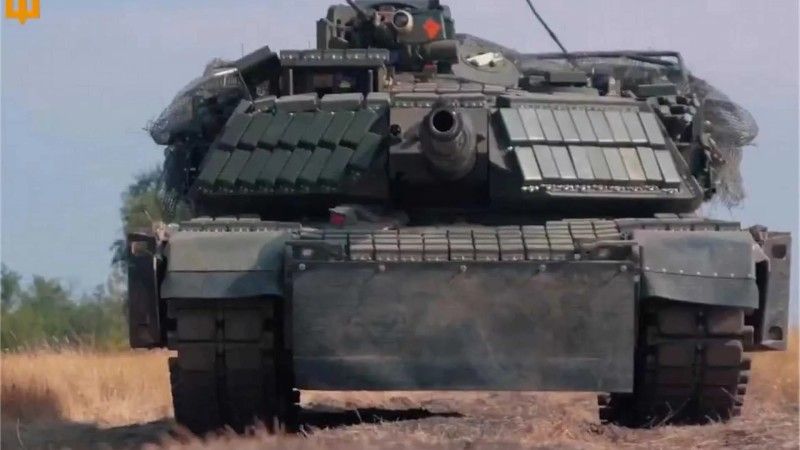
Photo. Ministerstwo Obrony Ukrainy
Ukraine has received a substantial number of Western tanks of several types as part of military aid. These include approximately 135 Leopard 1A5 vehicles, 74 Leopard 2A4s, 21 Leopard 2A6s, 10 Strv 122A tanks — Leopard 2S — 33 M1A1SA-UKR tanks, 49 M1A1AIMs, and 14 FV4034 Challenger 2 tanks.
From this article you will learn:
- How Ukraine's current armored-vehicle inventory looks
- What tank losses Ukraine has suffered
- What the main causes of losses among Ukrainian armored vehicles are
Below we present the individual tank types and the current inventory held by the Ukrainian Armed Forces. The loss data presented are based on an analysis of Russian photographic and video materials from the Lost Armour website.

Photo. 47. Mechanized Brigade
M1A1SA-UKR and M1A1AIM Abrams
Ukraine received two batches of M1A1 Abrams tanks. From the United States it obtained 33 tanks in the M1A1SA-UKR variant, while Australia supplied 49 vehicles in the M1A1AIM variant. In total, this amounts to a fleet of 82 machines that are being intensively operated at the front and have been taking part in combat since February 2024. Eighty-two tanks would allow the equipping of two tank battalions, each with 31 vehicles, as well as two additional companies of 10 vehicles each.
On the basis of available sources, we can determine that, to date, the Russians have managed to successfully hit 25 tanks of this type, or 30.4% of the total pool. Only completely burned-out vehicles are classified as destroyed; these number 10, or 12.1% of the initial inventory. There are 15 damaged and abandoned vehicles, or 18.2%, of which five, or 6%, were seized by the Russians and evacuated to the rear as war trophies.

Photo. 160th Separate Mechanized Brigade
Thus, 57 vehicles remain in the inventory of the Ukrainian Armed Forces, or 69.5% of the initial stock. This allows for the arming of one standard tank battalion of 31 vehicles. In addition, there are 26 tanks, enough to equip one understrength battalion. These tanks have demonstrated high resistance to hits, as well as the highest level of crew safety and survivability.

Photo. 142nd Mechanized Brigade of the Armed Forces of Ukraine.
Leopard 1A5
Western European states transferred around 135 Leopard 1A5 tanks to Ukraine. Of this pool, 35 vehicles of this type have so far been recorded as having been hit by the Russians, or 25.9% of the overall fleet. Twenty-six vehicles have been destroyed, or 19.2%, while nine vehicles have been damaged, or 6.6%. This means that around 100 tanks remain in service, or 74% of all vehicles transferred.
Interestingly, not a single tank has been captured by the Russians and evacuated to the rear. This is most likely due to the fact that Leopard 1 tanks are obsolete and are treated as low-value captures because of their very weak armor, made only of homogeneous cast and rolled armor steel.

Photo. General Staff of the Armed Forces of Ukraine / X
Leopard 2A4
NATO countries transferred around 74 tanks of this type to Ukraine. Of this pool, 25 vehicles have been hit, or 33.7%. Twenty-one examples have been destroyed, or 28.3%; three are damaged and abandoned, or 4%; while the Russians managed to capture one vehicle, amounting to 1.3% of the total.
There should still be 49 examples remaining in the inventory of the Ukrainian Armed Forces, or 66.2% of the total. This allows for the equipping of one full tank battalion and two understrength companies. Leopard 2A4 tanks suffer mainly from insufficient armor protection because of their outdated base composite armor. Improvised additional protection is unable to offset this problem.
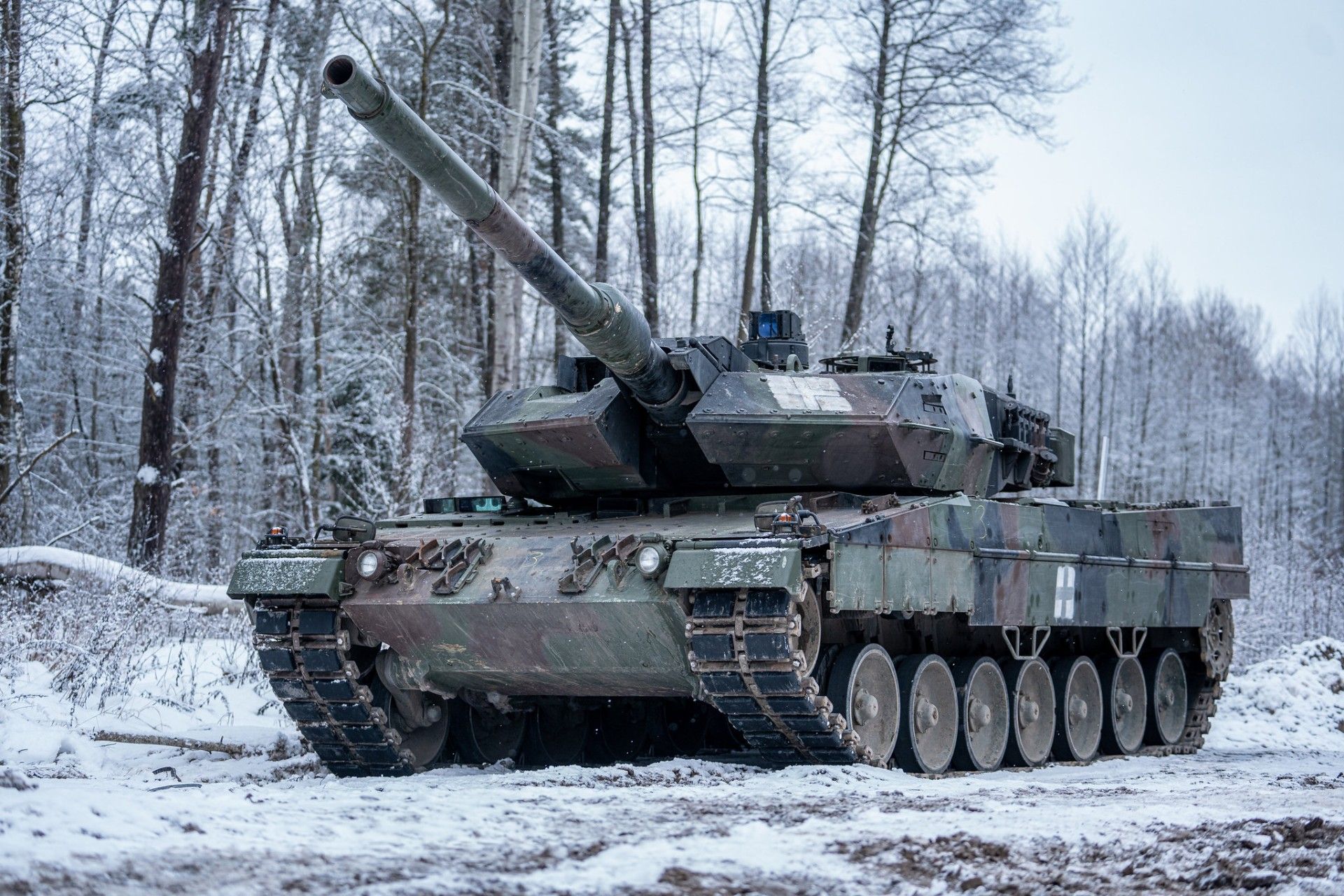
Photo. Lithuanian MOD/X
Leopard 2A6
Ukraine received 21 examples of the more modern Leopard 2A6 tank. Of this number, 10 have been hit, or 47.6%. Seven tanks have been destroyed, or 33.3%, while two vehicles are damaged, or 9.5%. One tank, or 4.7%, was captured and evacuated by the Russians.
This means that 11 Leopard 2A6 tanks remain in the inventory of the Ukrainian Armed Forces, representing 52.3% of the total fleet received. It turned out that Leopard 2A6 tanks also have a problem with obsolete composite armor protecting the front of the hull, which in at least one case was penetrated by a relatively small shaped-charge warhead carried by an FPV drone.

Photo. 21st Separate Mechanized Brigade/Facebook
Strv 122A (Leopard 2S)
Sweden transferred 10 Strv 122A tanks — Leopard 2S — to Ukraine. This is the most heavily armored Leopard 2 model that has been transferred to Ukraine. In total, at least nine of these vehicles have certainly already been hit, or 90%. Two examples were destroyed, or 20%, while five vehicles were damaged, or 50%, of which two, representing 20%, were captured and evacuated by the Russians. One vehicle may remain in service, or 10% of the company transferred.
These tanks are characterized by high resistance to hits, but their small number means that their presence on the front line is of little significance from an operational point of view. If the damaged and abandoned vehicles could not be evacuated by the Ukrainians, the fleet of this equipment has essentially ceased to exist.

Photo. Генеральний штаб ЗСУ / General Staff of the Armed Forces of Ukraine/Facebook
FV4034 Challenger 2
The United Kingdom transferred 14 FV4034 Challenger 2 tanks to Ukraine, which corresponds to one standard NATO tank company. Of these 14 vehicles, two have been successfully hit and destroyed by the Russians. This means that 14.2% of the fleet has already been eliminated from combat.
However, due to the low availability of spare parts and ammunition, the operation of Challenger 2 tanks is difficult. This means that they are most likely not present on the front line in large numbers and may be used rarely, if at all, assuming this fleet is still operational.

Photo. Rusłan Tarasow/ ArmyInform
PT-91 Twardy
According to available sources, Poland transferred around 60 PT-91 Twardy tanks to Ukraine. Of this number, the Russians have already managed to hit 12 vehicles, or 20%. Ten vehicles have been destroyed, or 16.6%, while two tanks are damaged, or 3.3%.
Around 48 vehicles probably remain in service, or 80% of all those transferred. PT-91 Twardy tanks have demonstrated battlefield survivability typical of modernized vehicles from the T-72 family. For the Russians, these vehicles are not interesting, and they probably have not attempted to capture even a single example.

Photo. MORS/ Wikipedia
M-55S1
Slovenia transferred to Ukraine 28 of the 30 T-55 tanks it possessed, modernized to the M-55S1 standard — alternative designation M-55S. The Russians have hit five vehicles, or 17.8% of the total, and all of them were destroyed.
This means that 23 vehicles remain in service, or 82.1%. These vehicles, like the Leopard 1s, are used mainly as fire-support vehicles because of their outdated and ineffective armor. For the Russians, they do not constitute an important target in the way modern Western tanks do, nor are they of interest as trophies.
Loss data
Armed Forces of Ukraine - Statistics on losses of MBTs, Western vehicles
| Vehicle type | Total number of vehicles | Vehicles hit | Vehicles destroyed | Vehicles damaged | Vehicles captured | Vehicles still in inventory | ||||||||
| M1A1SA-UKR, M1A1AIM | 82 | 25 (30.4%) | 10 (12.1%) | 15 (18.2%) | 5 (6%) | 57 (69.5%) | ||||||||
| Leopard 1A5 | 135 | 35 (25.9%) | 26 (19.2%) | 9 (6.6%) | 0 | 100 (74%) | ||||||||
| Leopard 2A4 | 74 | 25 (33.7%) | 21 (28.3%_ | 3 (4%) | 1 (1.3%) | 49 (66.2%) | ||||||||
| Leopard 2A6 | 21 | 10 (47.6%) | 7 (33.3%) | 2 (9.5%) | 1 (4.7%) | 11 (52.3%) | ||||||||
| Strv 122A (Leopard 2S) | 10 | 9 (90%) | 2 (20%) | 5 (50%) | 2 (20%) | 1 (10%) | ||||||||
| FV4034 Challenger 2 | 14 | 2 (14.2%) | 2 (14.2%) | 0 | 0 | 12 (85.7%) | ||||||||
| PT-91 Twardy | 60 | 12 (20%) | 10 (16.6%) | 2 (3.3%) | 0 | 48 (80%) | ||||||||
| M-55S1 | 28 | 5 (17.8%) | 5 (17.8%) | 0 | 0 | 23 (82.1%) | ||||||||
Statistics on losses of main battle tanks transferred by NATO to Ukraine. Author: Damian Ratka/Defence24
Summing up…
In summary, Western tanks are characterized by relatively high resistance to hits and crew survivability. The M1A1SA-UKR and M1A1AIM Abrams tanks, as well as the Strv 122A, stand out particularly well in this regard. The remaining vehicles unfortunately have worse resistance and survivability characteristics.
The fundamental problem facing Ukrainian armored equipment is the lack of active protection systems that could effectively protect the more lightly armored surfaces of vehicles against attacks by FPV-class unmanned aerial vehicles carrying shaped-charge warheads. Another problem is the widespread presence of mines, which immobilize vehicles in the field and make it easier for the Russians to attack them.


