



- WYWIADY
- WIADOMOŚCI
How is the East Shield being built? Chief of Military Engineering reveals details [INTERVIEW]


In our conversation with Brig. Gen. Mariusz Ochalski, Chief of the Military Engineering Directorate of the General Command of the Armed Forces, we discuss the East Shield, the challenges connected with this project, and the progress made so far.
Jędrzej Graf, Maciej Szopa: The Engineering Troops are heavily involved in the East Shield. From your perspective, what does this project look like? What is the biggest challenge today, and what are the plans for this year?
Brig. General Mariusz Ochalski: The East Shield, even if we look only at its engineering component, is a multidimensional defence undertaking. A significant part of it remains in the planning layer. I will not discuss what is happening in that area, but what is being implemented can be seen in the field. Above all, we are trying to save time — time which, in the event of a worsening threat or possible escalation, becomes extremely critical. Everything we do today buys time for the future.
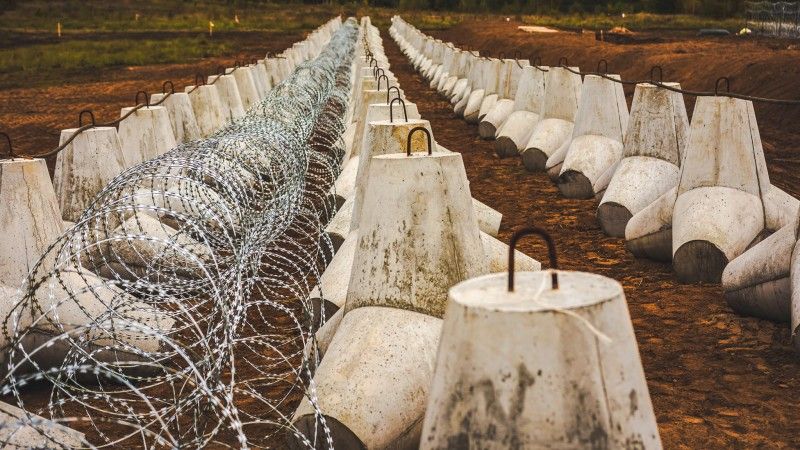
The delivery of materials is ongoing, and these materials are a very important element of countermobility. You cannot secure a border with earth and shovels alone, and mines are also laid at the last moment. By contrast, deploying physical elements such as those we see under the East Shield — including these “hedgehogs” — is a time-consuming process. The key issue is delivering them to the areas where they will be used and constructing the line that directly secures the border.
Is that a challenge?
In peacetime, all legal and systemic restrictions remain in force. Today there is no law that would allow the military to do whatever it wants, as would be the case under wartime conditions. Although the regulations have been somewhat amended and certain procedures have been simplified, land still has to be acquired.
For the military to construct any structures, even field fortifications, it must have legal rights to the land — either through lease or ownership. We cannot simply enter a field because we like it and start operating there from that moment on.

Photo. Polish MoD
Is there a problem with acquiring this land?
So far, we have acquired a certain number of kilometres along the border for this linear, direct expansion, in accordance with the adopted concept of engineering development. This concerns a 400-metre border strip as the first element of the so-called obstacle belt. However, this is only part of the expected fortification development. The rest is taking place largely at the planning level and is not yet visible.
Because full access to the terrain is not available, we are considering the possibility of acquiring land on the basis of a “multi-year loan,” with the possibility of extension and financial compensation. I would not like to elaborate on this, because it is a matter for politicians, but the need exists.
So the land requirements are greater than what has been acquired so far. How, then, is the East Shield being built?
At present, we are constructing storage sites. These have now become the foundation of the entire formula. It is easier to acquire land for a storage site that will secure material for many kilometres of future use than to immediately buy all those kilometres from owners.
When it comes to acquiring land, there are many challenges. The landowners are farmers. Their plots do not always correspond to our needs, so we have to divide them, working with KOWR — the National Support Centre for Agriculture. The entire procedure related to agricultural leasing is conditioned by many legal factors, and this creates conflict situations.
How many storage sites have been created so far?
In 2025, we created a number of such sites based on military facilities already in our possession. This year, we are moving onto land acquired through KOWR or made available after administrative procedures. We are working here with the respective Regional Infrastructure Boards, which act as the acquiring party, and with the Territorial Defence Forces. In practice, these areas are formally acquired by the Territorial Defence Forces, while we are the executor of the engineering tasks connected with preparing the linear expansion or the storage sites.
By the end of last year, we had secured approximately 100 km of practical length of border-area terrain that we were supposed to secure. Of course, if counted strictly according to the concept, the figure is slightly lower. However, we must recognise that, to a large extent, the terrain in a certain sense defends itself, and we take that into account as well.
So, out of the expected target length of about 500 km, those completed 100 km are the first step. This year, another roughly 20 storage sites are planned, plus several dozen kilometres of linear expansion. I hope that in practice we will be able to carry out this expansion to a greater extent than last year. I expect that by the end of the year we will reach almost 50 percent of what was assumed under the East Shield.

Photo. Jakub Borowski, Defence24.pl
50% in 2 years then?
The second element that requires a broader approach is ensuring mobility. The real owners and administrators of roads are highly dispersed. The problem lies primarily with roads close to the border, of lower significance, which are managed by local authorities. It is difficult to say that all these roads are roads of defence importance, which would automatically involve the Ministry of National Defence imposing obligations and financing construction from its own funds.
Together with the Infrastructure Department and other ministries, we are therefore trying to encourage local governments to make investments that can be refinanced by the military. A series of meetings with local-government officials has already taken place and is continuing. We are looking for a balance between defence needs and local capabilities.
The second aspect in the area of mobility is building awareness regarding terrain parameters. Here, artificial intelligence is slowly entering the Armed Forces, as is multi-parameter processing in the form of Big Data. We are working with the Road and Bridge Research Institute on a solution that would allow us to use all available data: road curvature parameters, embankments, and other elements. Today this has to be read from a map, which requires effort. Technology, however, shows that it can make our work easier, and we are already slowly testing this in a digital environment.
We are also trying to link civilian knowledge with military requirements. From our point of view, this is primarily defence planning related to decisions on demolitions — where to carry out a demolition, what effect it will have on the enemy and on our own forces, and how to find a bypass around a destroyed road.
Are these AI systems that you want to implement, or are you already working on them?
We are already working on them. Individual engineering-action scenarios have been developed — several dozen such scenarios have already been prepared in preliminary form. They need to be entered into the system and tested. For now, the Territorial Defence Forces Command is working on developing the system and linking external data. This is still something for the future, but we are already thinking about it very intensively.
Another area is physical preparation for restoring destroyed infrastructure. It is clear that military capabilities are limited compared with the industrial sector or civilian companies. Today, however, there are no mechanisms that would allow this potential to be used easily. Materials also have to be stored — whether these are to be full-size bridges or so-called improvised bridge structures meeting minimum military requirements in order to secure movement.

Photo. Jakub Borowski, Defence24.pl
Are we talking about major water obstacles or about lower-echelon operations?
This concerns the lower echelon, where a crossing has to be restored quickly for a single vehicle without extensive specialist knowledge. There are not many bridge units, but construction solutions do exist — for example, modular bridges, where even a squad, after light training, can build a structure that meets wartime requirements.
We would like to ask about minelaying. Industry has declared a return to mass mine production, but the tools are also important — that is, what we intend to use to lay mines. Many ideas are appearing from domestic industry. How do you approach this?
The Baobab system currently being implemented is certainly a very important element, because it increases capabilities by an order of magnitude compared with what we had. We are taking advantage of the fact that industry is finally delivering it — the first units will be delivered this year, and more will follow next year. This will allow tasks to be carried out much faster.
The dilemma is whether to copy solutions from Ukraine, or whether this war will look the same in the future. Automation and reducing the use of human personnel in order to avoid losses are certainly leading trends. The challenge lies in the procedural process — how to massively “drone-ise” the military. Regulations and the capability-acquisition system are not keeping pace.
So you are also conducting checks and tests of various unmanned systems?
For now, we are familiarising ourselves with and observing solutions. There are many ideas, and we do not want to close ourselves off to one company, especially since there are not yet general technical requirements for drones or for the approach to minelaying.
Today, for us, drone-based mine-laying — what the Ukrainians are doing — means replacing the soldier who previously carried out a raid to lay mines, for example, an intersection. The means and depth of action are changing, because fibre-optic drones today fly several dozen kilometres behind the lines. Baobab is used for minelaying within our own formation, whereas we are looking for a solution for how to lay mines beyond the horizon, in the enemy’s rear area.
In Ukraine, for example, supply routes are observed and the enemy’s logistics routes are covered with mines. It is difficult to use mine-clearing assets on a supply road every single time. Ukraine also uses ground drones where a soldier cannot reach. We are familiarising ourselves with these solutions and assessing them, but we must remember that implementing new technological systems entails comprehensive changes — organisational, structural, logistical, and doctrinal. The implementation of such revolutionary solutions will definitely require a change in Land Forces doctrine. One of the regiments has been designated to demonstrate such solutions, and we are, of course, focusing on what is ready for implementation.
Are you considering a return to traditional minelaying methods?
That is not a major challenge. The problem is more the means of delivery. The mines used in the past no longer exist. Recreating those solutions using new mines is a process. It cannot be done immediately. One direction is acquiring solutions as part of the development of the Korean Chunmoo rockets. The question is whether, as part of production in Poland, we can also use their minelaying solutions.
Armament Agency is aware of that. There are also ready-made American solutions, but they are not always made available to other countries. There was also a concept of using 122 mm or 155 mm calibres for minelaying. Financial limitations, however, do not allow us to pursue every direction, so analysis will show what should be selected. Minelaying is one of many capabilities that we must quickly rebuild after years of funding shortfalls.

Photo. 2nd Regional Logistics Base
So minelaying capabilities are currently a priority?
Yes, I have already said a lot about that. Gap-crossing capabilities are also important. This year, the first modules of the PFM — the Motorised Pontoon Bridge — are being introduced into the Armed Forces. Soldiers from two regiments are undergoing training. Military testing lies ahead of us so that the system can be described in manuals. I think that next year we will see the first exercises using PFM in a tactical setting.
The challenge is also how to conduct crossings under conditions of permanent surveillance. The conflict in Ukraine shows that this is an operational dilemma. Camouflage, deception, and simulation must be introduced consciously, not for show. For many years, during exercises, we often deceived ourselves by simplifying crossing issues in order to meet other objectives. The assumption that we have calm conditions is wrong. We must understand the realities: how long a crossing remains open, what participates in its protection, and how the entire camouflage system functions.
Camouflage is not just a branch attached to headgear — it consists of four different elements. Deceptive actions, the construction of dummy positions — this is our responsibility. We want mock-ups to be introduced together with every new piece of equipment entering the military.
But here our industry — for example, the Lubawa Group — seems to have ready-made solutions and even export successes?
Yes, this has to be connected. If we introduce new equipment, and the requirements were described a few years ago, mock-ups are often not included in the package. We have to catch up with that. A mock-up does not have to be perfect — there will always be some nuance in technical testing. The question is what matters more: technical perfection or operational value? After all, not every drone in Ukraine has thermal imaging.
We have new solutions, such as the Berberys camouflage net — another generation with very good parameters. But if it is used improperly, for example by placing it directly on equipment, its parameters decline. This is a matter of awareness and training. Protective covers are also being introduced, along with individual camouflage, previously known mainly in special forces or among snipers. We want this to become common. Everyone must take care of their own equipment and know how to camouflage it. We do not have the resources or the ability for sappers to take care of every single vehicle in the Armed Forces.


